
What construction can learn from Ant colonies about logistics and site movement
If you want to witness flawless logistics, responsive movement and coordinated planning in action, you do not need to observe a hyper-automated warehouse or a cutting-edge construction site - you only need to look down at an ant colony. Beneath our feet exists a complex system that manages material transport, labour allocation and spatial navigation with an efficiency that the construction industry struggles to match. While ants are tiny, the principles that underpin their organisation offer valuable lessons for improving workflow, site circulation and resource deployment in the built environment.
Nature has had millions of years to refine processes that humans continue to grapple with. Ant societies display astonishing organisational behaviour without a central command structure. Each member operates according to simple rules while contributing to a collective goal. Construction, by contrast, is driven by centralised decision-making through managers, planners and supervisors. Yet despite this hierarchy, miscommunication, delays and bottlenecks are common. If we examine how ants coordinate movement and manage material flows, it becomes clear that decentralised logic, responsive pathways and adaptable networks can enhance site operations.
One of the most fascinating aspects of ant organisation is how they optimise movement routes. When searching for food, ants initially scatter until one discovers a viable resource. It then lays a pheromone trail back to the colony. Other ants follow the trail and reinforce it, while weaker or longer routes gradually fade. This simple feedback mechanism results in the shortest and most efficient route becoming dominant.
On construction sites, movement patterns often evolve without strategic planning. Site workers may waste time navigating obstacles, crossing unsafe or congested areas and repeating inefficient routes. Logistics might rely on static plans that do not change even when conditions shift. If site circulation was treated as an evolving system, pathways could be refined based on real-time use rather than overly rigid preconceptions. Digital tracking, wear sensors or temporary markings could highlight natural desire lines, helping planners adjust circulation in response to actual site behaviours. Ants demonstrate that optimal pathways emerge through iteration rather than prediction.
Distributed decision-making and autonomy
Another lesson lies in distributed intelligence. Ant colonies function through individual initiative rather than rigid hierarchy. Each ant responds to environmental cues, adjusting its role based on immediate needs. If a blockage occurs, ants do not wait for instruction; they reroute or reassign themselves. This adaptability ensures continuity of movement and prevents small disruptions from escalating.
Construction workflows can be slow to respond to unexpected changes because frontline workers often require sign-off before altering tasks. While safety demands oversight, autonomy in micro-decision-making could reduce downtime. Allowing workers to propose adjustments, request resources or reassign effort through digital tools could mirror the responsiveness that ants display. Real-time communication platforms, flexible planning and delegated authority can create a more elastic workforce capable of navigating uncertainty.
Ants transport materials over long distances, often building bridges and clearing obstacles to maintain flow. They adjust the number of workers on a task according to demand. When resources are plentiful, more ants join the effort, and when they dwindle, labour shifts elsewhere. This fluid redistribution is critical to maintaining productivity.
Construction sites frequently suffer from two extremes with overcrowding on some tasks and scarcity on others. Equipment might sit idle while labour queues form, or materials may be stockpiled inefficiently, leading to damage or delay. A resource allocation system inspired by ant behaviour would be dynamic rather than static. Instead of pre-allocating labour to tightly sequenced tasks, a real-time overview of productivity could trigger redeployment when output falls behind or surges ahead. Ants illustrate the power of continual recalibration rather than rigid task assignment.
Collective awareness without central control
Ant colonies thrive on shared understanding. Through pheromones and tactile signals, they maintain awareness of obstacles, opportunities and priorities. Communication is constant, subtle and efficient. Construction projects often rely on periodic briefings or written plans. By the time information reaches workers, conditions may already have changed.
Incorporating continuous micro-communication could streamline movement and coordination. Wearables, sensors and positioning systems could act as digital pheromones, broadcasting location, status and hazards to everyone on site. Instead of transmitting instructions from the top down, information could circulate laterally, creating collective intelligence. The power of the ant model lies in enabling workers to act on shared context rather than waiting for formal directives.
Ants also excel at resilience. When flood, collapse or competing colonies interfere with their movement, they adapt with astonishing speed. Their networks reconfigure, pathways reroute and priorities shift. Construction sites face constant change such as weather, supply delays, unexpected clashes and modified designs. Yet the industry’s standard response tends to be reactive rather than anticipatory.
Ant-inspired logistics would embrace adaptability as a core principle. Instead of assuming that plans will hold firm, digital modelling could simulate alternative pathways, multiple contingency arrangements and flexible work sequences. If materials cannot reach one location, resources could be redirected without halting progress. The difference lies in designing logistics frameworks that expect disruption rather than resist it.
Ants learn through repetition. Successful routes are reinforced, and unsuccessful ones fade. The industry often lacks this behavioural feedback because lessons are documented after the fact rather than during activity. Recognising movement inefficiencies in real time would enable immediate improvement rather than retrospective reporting.
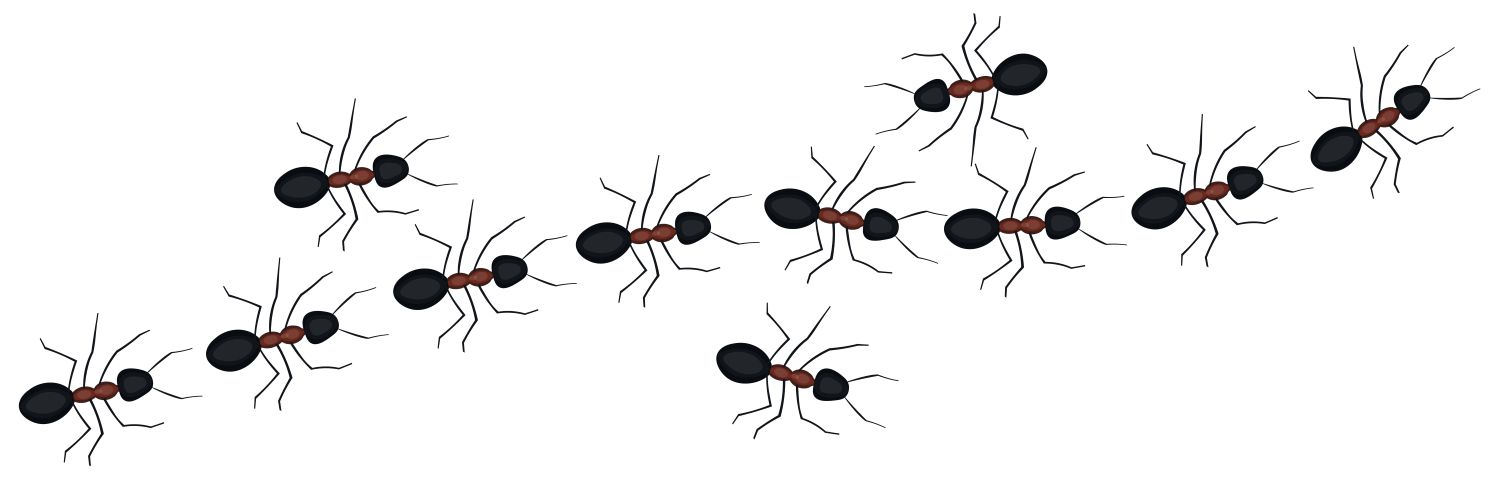
Sensor-based tracking, drone mapping and workforce feedback could create iterative learning loops. Over time, preferred routines would emerge, and inefficient patterns would disappear. The construction environment would evolve organically rather than relying on assumptions.
A future of biomimetic construction sites
Imagining, therefore, a construction site influenced by ant behaviour is not science fiction. It would feature dynamic pathways marked by real-time usage, autonomous materials handling supported by robotics, flexible labour allocation based on demand and constant micro-communications through digital networks. Instead of rigid control, coordination would arise from shared awareness and iterative refinement.
This vision challenges the traditional command-and-control model of construction logistics. It proposes a more adaptive, decentralised and feedback-driven approach that mirrors natural systems. Ant colonies demonstrate extraordinary efficiency not through intelligence but through simple rules applied consistently. Construction could benefit from adopting similar principles, creating sites that flow smoothly, respond quickly and evolve continuously.
As construction embraces digital transformation, modular delivery and lean principles, it stands at a pivotal moment. The opportunity is not merely to digitise existing processes, but to reimagine them entirely. Ant colonies remind us that the most effective logistics systems are not necessarily the most technologically advanced, but the most attuned to the environment, adaptable in structure and collaborative in nature.
By studying how these tiny organisms orchestrate monumental feats through decentralisation, responsiveness and iterative optimisation, the construction industry can rethink how it moves people, materials and information. Nature has already perfected efficiency; our challenge is to learn from it.
Additional Articles

The 3,000-Year History of Scaffolding
The basic idea behind scaffolding is far older than steel, standardised fittings or modern health and safety. In fact, the first scaffolds were probably nothing more sophisticated than wooden poles...
Read moreThe Victorian ventilation revolution and what we forgot
Long before air conditioning, Victorian architects were designing buildings around a problem that has returned with a vengeance. How do you keep large, crowded buildings supplied with fresh air...
Read more

Why Georgian houses have surprisingly thin walls
Walk into a Georgian townhouse and the proportions can feel almost impossibly elegant. Tall windows, narrow façades and beautifully ordered brickwork give the impression of lightness. Yet behind that...
Read more