
The elevator that changed the world when Elisha Otis cut the rope
Today, stepping into a lift is one of the most routine acts of modern life. We press a button, glance at the floor indicator, and trust, almost without thinking. that a metal box will safely carry us dozens of metres into the air. But in the mid-19th century, the idea of riding inside a suspended platform was terrifying. Elevators, or lifts as we call them in the UK, existed, but they were widely considered unsafe, unreliable and suitable only for freight. That changed dramatically in 1854, when a man named Elisha Otis climbed into an elevator and cut the rope.
The first elevators were not invented for people at all. Ancient civilisations, including the Romans, used basic hoisting platforms powered by humans, animals, or waterwheels. In the Colosseum, lifts raised animals and scenery through trapdoors beneath the arena floor, proof that vertical transport is far older than skyscrapers.
By the early 1800s, steam-powered elevators were being used in factories, mines and warehouses. They worked well enough for moving goods, but they were dangerous. If the rope or chain snapped, the platform would plunge to the bottom. Accidents were common, and the idea of putting people inside these machines was unthinkable.
As a result, buildings were designed very differently. Lower floors were the most valuable and prestigious. Upper floors were cheaper, less desirable and often occupied by servants or the poor. The US phrase “living in a walk-up” was not aspirational, it was a sign of lower status.
The most dramatic product demo in history
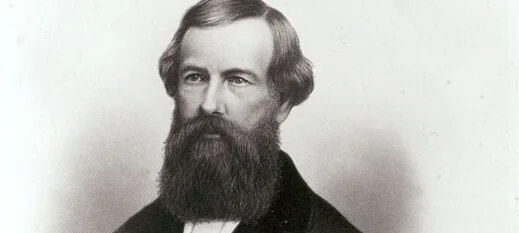
Elisha Otis ( Pictured above) didn’t invent the elevator. What he invented was something far more important: a safety brake that stopped the platform if the lifting rope failed and in 1854, at the Crystal Palace Exhibition in New York, Otis staged what is still considered one of the greatest live demonstrations in engineering history. Standing on an open elevator platform, he instructed an assistant to cut the hoisting rope with an axe. The rope snapped. The platform dropped slightly and then stopped.
Otis reportedly turned to the stunned crowd and declared, “All safe, gentlemen.” That single moment transformed public perception. Elevators were no longer death traps - they were machines that could be trusted. Within decades, cities would grow upward instead of outward.
It’s no exaggeration to say that modern cities exist because of elevators. Before safe lifts, buildings rarely exceeded six or seven storeys, the maximum most people were willing to climb. After Otis, height became an asset. By the late 19th century, elevators had become faster, enclosed and powered by electricity instead of steam. Office buildings began stacking businesses vertically. Hotels placed their most expensive rooms at the top, where views and privacy were best. The social hierarchy of buildings flipped upside down.
A quirky fact, to bring in at this stage. The Eiffel Tower originally included elevators powered by water pressure, using complex systems of counterweights and pistons. They were engineering marvels in their own right and terrifying to ride.
That said, despite lingering fears, elevators are extraordinarily safe. In fact, you’re far more likely to be injured using stairs. Modern elevators use multiple independent safety systems such as steel cables with redundancy (each cable alone can support the car), electromagnetic brakes, speed governors, buffers at the bottom of shafts and software monitoring every movement.
Even if all power is lost, elevators are designed to stop safely between floors, not fall. The classic nightmare scenario of plummeting to the ground, is essentially impossible in a modern lift.
Another surprising fact is that elevator doors are among the strongest doors in any building, designed to withstand impact, fire exposure, and repeated use millions of times over their lifespan.
The world’s strangest elevators
Elevators have in fact evolved in fascinating and sometimes bizarre ways:
- The Bailong Elevator in China is the world’s tallest outdoor lift, rising 326 metres up a cliff face in a glass enclosure.
- In Stockholm, the Katarina Elevator connects street level to a bridge, functioning more like vertical public transport than a building feature.
- Some luxury buildings now feature private elevators for individual apartments, eliminating shared lift lobbies entirely.
- The Vatican has its own elevators, discreetly hidden within centuries-old stonework.
In Japan, elevator etiquette is so precise that designated “elevator attendants” in department stores manually guide passengers, bow, and announce floors, despite the system being fully automated.
One curious question - if elevators are automated, why do we still press buttons?
Partly, it’s psychological. Studies have shown that passengers feel more comfortable when they believe they have control, even if the system could operate more efficiently without input. Some modern buildings already use destination-control systems, where you select your floor before entering and the lift assigns you to a car.
Another quirky fact - in many elevators, the “close door” button doesn’t actually do anything. In several countries, it’s required for accessibility regulations, but pressing it has no effect unless a maintenance key is used.
Elevators shape human behaviour
Elevators have even influenced social norms. The awkward silence, avoidance of eye contact and brief conversations about weather or floor numbers are all responses to forced proximity in a confined space.
Architects and designers now carefully consider elevator placement, lighting, mirrors and finishes to reduce discomfort. Mirrors weren’t added for vanity, they were introduced to make lifts feel larger and distract passengers from the sensation of movement.
Elevator technology is still evolving. Some companies are developing ropeless elevators that use magnetic levitation, similar to high-speed trains. These systems could move not just vertically, but horizontally, allowing multiple cars to circulate within a single shaft.
If successful, buildings could be designed with entirely new forms, unconstrained by traditional lift cores. Once again, elevator innovation may reshape architecture itself, just as Otis did 170 years ago.
Elisha Otis’s rope-cutting demonstration didn’t just prove a safety mechanism, it changed how people thought about height, risk and the future of cities. Without that moment of theatrical confidence, skyscrapers might have remained fantasies and urban life would look very different today.
So, every time you step into an elevator, you’re participating in a legacy that began with a bold engineer, a sharp axe and a crowd holding its breath. The ride may feel ordinary, but the history behind it is elevating.
Additional Articles
The 3,000-Year History of Scaffolding
The basic idea behind scaffolding is far older than steel, standardised fittings or modern health and safety. In fact, the first scaffolds were probably nothing more sophisticated than wooden poles...
Read moreThe Victorian ventilation revolution and what we forgot
Long before air conditioning, Victorian architects were designing buildings around a problem that has returned with a vengeance. How do you keep large, crowded buildings supplied with fresh air...
Read more
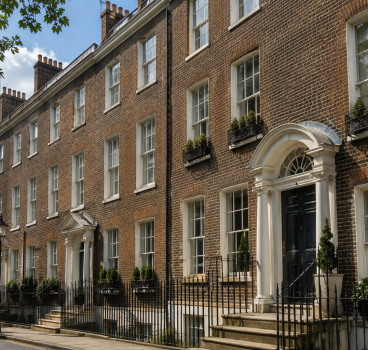
Why Georgian houses have surprisingly thin walls
Walk into a Georgian townhouse and the proportions can feel almost impossibly elegant. Tall windows, narrow façades and beautifully ordered brickwork give the impression of lightness. Yet behind that...
Read more