
Cold bitumen emulsion-based asphalt proves its place on the strategic road network
Delivering lower-risk, standards-compliant solutions on the strategic road network (SRN) has traditionally required extensive trials and layers of approval. But a recent scheme across the A26 Beddingham and A259 Winchelsea is challenging that assumption by demonstrating that lower-carbon solutions can be delivered within existing standards – without increasing delivery or commercial risk.
In a UK-first for the SRN, Roadways has successfully delivered cold bitumen emulsion-based asphalt as a direct replacement for conventional AC20 binder, marking a significant milestone in the adoption of sustainable materials at scale.
A new approach within existing rules
Working for National Highways under the South East Alliance and PDF2 framework, Roadways delivered approximately 1,300 tonnes of cold bitumen emulsion-based asphalt across the A26 at Beddingham and the A259 at Winchelsea.
Crucially, the scheme required no departures from the Specification for Highway Works. Clause 948 provided the framework for a fully compliant alternative to traditional warm-mix AC20 binder. By positioning cold bitumen emulsion-based asphalt as a like-for-like replacement rather than an experimental material, the project redefines how innovation can be introduced onto the SRN.
Challenging conventional delivery risks
Hot and warm-mix asphalt binders have often been the default for resurfacing schemes. However, they bring inherent constraints: tight temperature tolerances, logistical dependencies and exposure to heat-related risks during production and installation.
They also rely heavily on virgin
aggregates and energy-intensive manufacturing processes, with bitumen heated to
high temperatures to achieve coating, factors that contribute to both carbon
impact and potential material brittleness over time. Roadways asked the
question: could a lower-carbon, lower-risk alternative be delivered without
altering pavement design, layer thickness or programme expectations?
From technical query to full-scale delivery
Roadways initiated the solution through early technical engagement, raising a design query that led to collaboration with National Highways and scheme designers. This proactive approach confirmed that cold bitumen emulsion-based asphalt could be deployed as a direct AC20 binder replacement within existing specifications.
Acting as principal contractor, material producer and installer, Roadways retained full control over the process, from mix design and production through to on-site laying. The material was manufactured using cold bitumen emulsion, ensuring consistent coating and controlled stiffness aligned with Clause 948 grading requirements. Production took place at Roadways’ local recycling facility in East Sussex, supporting efficient logistics across the South East. The binder course was then laid under controlled road closures, before being surfaced with a conventional hot asphalt wearing course.
Performance, resilience and safety
By removing the need for high-temperature production and installation, the cold bitumen emulsion-based asphalt approach delivered immediate operational benefits. Temperature sensitivity, a key risk factor in traditional asphalt delivery, was effectively eliminated, allowing for greater flexibility in transport and laying.
This translated into improved programme resilience, with more adaptable delivery windows and reduced susceptibility to delays. The ability to incorporate back-haul logistics further strengthened efficiency, minimising empty vehicle movements and optimising material flows.
Safety was also enhanced, with
reduced exposure to heat-related hazards for both production and site teams.
Circular materials, measurable carbon savings
Sustainability outcomes were central to the scheme’s success. The cold binder utilised 100% recycled aggregate, completely eliminating the need for virgin materials within the layer.
Planings removed from site were returned to the Sussex facility and reincorporated into subsequent production cycles, creating a closed-loop system that reduced haulage, handling and waste.
Across the 1,300 tonnes delivered, the scheme achieved an estimated saving of 23–25 tonnes of CO₂ compared with conventional warm-mix AC20. A further 2.4 tonnes of CO₂ were avoided through back-haulage and the elimination of empty return journeys. These savings were achieved without compromising performance or durability, demonstrating that carbon reduction does not require trade-offs in quality or compliance.
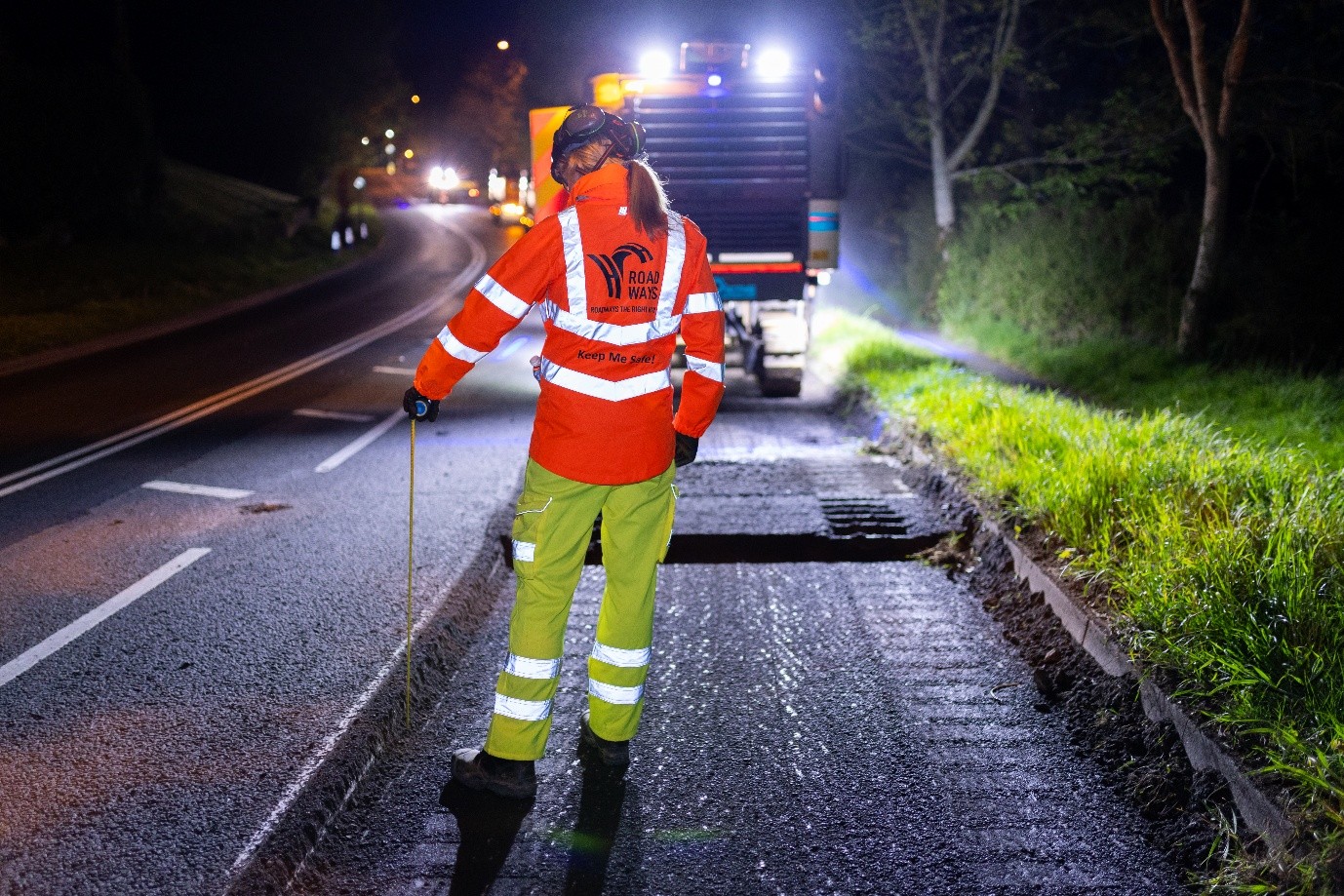
What distinguishes the A26 and A259 schemes is not just their technical success, but their replicability. By relying entirely on established specifications and proven processes, the approach can be adopted across the SRN without the need for bespoke approvals or changes to design standards. In addition to carbon and operational benefits, the approach offers improved commercial certainty, with lower exposure to fuel-driven price volatility compared to traditional hot-mix production.
The project also highlights the value of early contractor involvement. By engaging at the design stage, Roadways was able to identify opportunities, de-risk implementation and support the client in adopting a new approach with confidence.
A shift in mindset for highways delivery
The successful use of cold bitumen emulsion-based asphalt on the SRN signals a broader shift in the sector. Rather than viewing sustainability as dependent on new materials or revised standards, this project demonstrates the potential of existing specifications when applied with technical insight and delivery control.
By combining full self-delivery, controlled ex-situ production and intelligent logistics, Roadways has shown that cold bitumen emulsion-based asphalt is not an emerging concept, but a commercially viable, scalable solution for modern highways infrastructure. As pressure grows to decarbonise and improve resilience across the network, schemes like Beddingham and Winchelsea offer a clear message: the tools for transformation are already in place - the challenge is how effectively they are used.
Additional news

School fires at the start of term reveal the real cost of disruption
Pupils and teachers have returned to school this September, but a cluster of fire incidents over the summer has left some of them facing an uncertain and disrupted start to the new academic year....
Read more
Major 900-space car park approved for Cardiff Bay regeneration scheme
Cardiff Council has appointed GOLDBECK Construction to deliver a major new multi-storey car park as part of the ongoing regeneration of Atlantic Wharf in Cardiff Bay.
Read more