
What Viking longhouses teach us about building with the wind
When we think about strong buildings, we tend to think about resistance - thicker walls, stronger materials and heavier structures. The instinct is simple - if something might move, stop it moving, but Viking builders took a very different approach.
Instead of resisting the forces around them, they worked with them. Viking longhouses. Most especially the homes, halls and social centres of Norse life, were not rigid structures designed to stand immovable against the elements. They were flexible. They were designed to bend, shift and absorb energy, particularly in the face of strong winds. It’s a subtle idea, but it’s also a powerful one and surprisingly relevant today.
Viking settlements were typically located in some of the most exposed environments in Northern Europe, coastal regions, open plains and fjord landscapes where wind was not an occasional challenge, but a constant presence.
According to archaeological research compiled by the National Museum of Denmark, Viking Age longhouses (circa 8th–11th century) were constructed using timber frames combined with wattle-and-daub or turf walls, with long, low profiles that reduced exposure to wind, but the real intelligence wasn’t just in the shape, it was in how these buildings behaved.
Unlike modern buildings that often aim for rigidity, Viking longhouses were inherently flexible structures. Timber frames were assembled using joints that allowed for slight movement rather than locking everything into a fixed, immovable system. Walls made from woven branches (wattle) and coated in clay (daub), or constructed from turf, had a degree of give in them. Roofs, typically thatched, were lightweight and capable of absorbing movement rather than transferring stress through the structure.
Research highlighted by the University of Oslo notes that these construction methods allowed longhouses to respond dynamically to environmental loads, particularly wind. In simple terms, when strong winds hit the structure, it didn’t fight back rigidly - it moved.
Why Bending Works Better Than Fighting
Modern engineering understands this principle well. Structures that are too rigid can fail catastrophically when forces exceed their limits. Structures that allow controlled movement can dissipate energy and reduce stress concentrations.
We see this today in earthquake-resistant design, where buildings are engineered to sway rather than remain fixed. The same principle applies to wind.
According to the American Society of Civil Engineers, flexibility in structural systems can improve resilience by allowing buildings to absorb and redistribute loads rather than concentrating them in one point of failure.
The Vikings didn’t have wind tunnel testing or structural modelling software, but they had observation, experience and adaptation. They understood, instinctively or through trial and error, that a building that gives slightly is often stronger than one that refuses to move at all.
The shape of Viking longhouses reinforced this philosophy. They were long and narrow, with gently curved walls and low, sloping roofs. This reduced wind resistance and encouraged airflow over and around the structure rather than against it.
There were no sharp edges to catch gusts. No tall, flat surfaces acting as sails. Everything about the form worked to reduce pressure and distribute forces naturally.
This aligns with broader principles found in vernacular architecture, with buildings shaped by local climate and materials rather than imposed design ideals. The Encyclopaedia Britannica notes that traditional building forms across cultures often evolved to respond directly to environmental conditions, resulting in structures that were inherently more resilient because they were context-specific.
Materials That Made Sense
Another key factor was material choice. Viking builders used what was available - timber, earth, grass, reeds, but these materials weren’t just convenient. They were appropriate.
Timber, in particular, is naturally flexible. It can absorb and release energy without cracking in the way more brittle materials might. Combined with organic wall systems and lightweight roofing, this created buildings that were not only flexible but also forgiving under stress.
There’s an important distinction here. Modern construction often relies on high-performance materials engineered for strength. Viking construction relied on materials that were compatible with movement.
Despite their apparent simplicity, Viking longhouses were not short-lived structures. Archaeological evidence suggests many were maintained and adapted over long periods, with repairs and modifications made as needed. Their construction allowed for this. Materials could be replaced, sections repaired and systems adjusted without dismantling the entire building.
This adaptability is another form of resilience. Rather than designing for permanence in a fixed state, Viking builders created structures that could evolve over time.
What Changed in Modern Construction?
As construction evolved, particularly through the industrial era, the emphasis moved towards precision, control and permanence.
Materials became stronger, systems more standardised and structures more rigid. This brought huge advantages, such as scale, efficiency, predictability, but also introduced a tendency to design against forces rather than with them.
We now often rely on adding strength to overcome environmental challenges, rather than shaping buildings to reduce those challenges in the first place. That’s not inherently wrong, but it is a different philosophy.
The Viking approach offers a reminder of something important. Resilience does not always come from resistance. Sometimes, it comes from adaptability.
In a world where climate conditions are becoming less predictable, with stronger winds and more extreme weather events, there is growing interest in designing buildings that can respond dynamically to their environment.
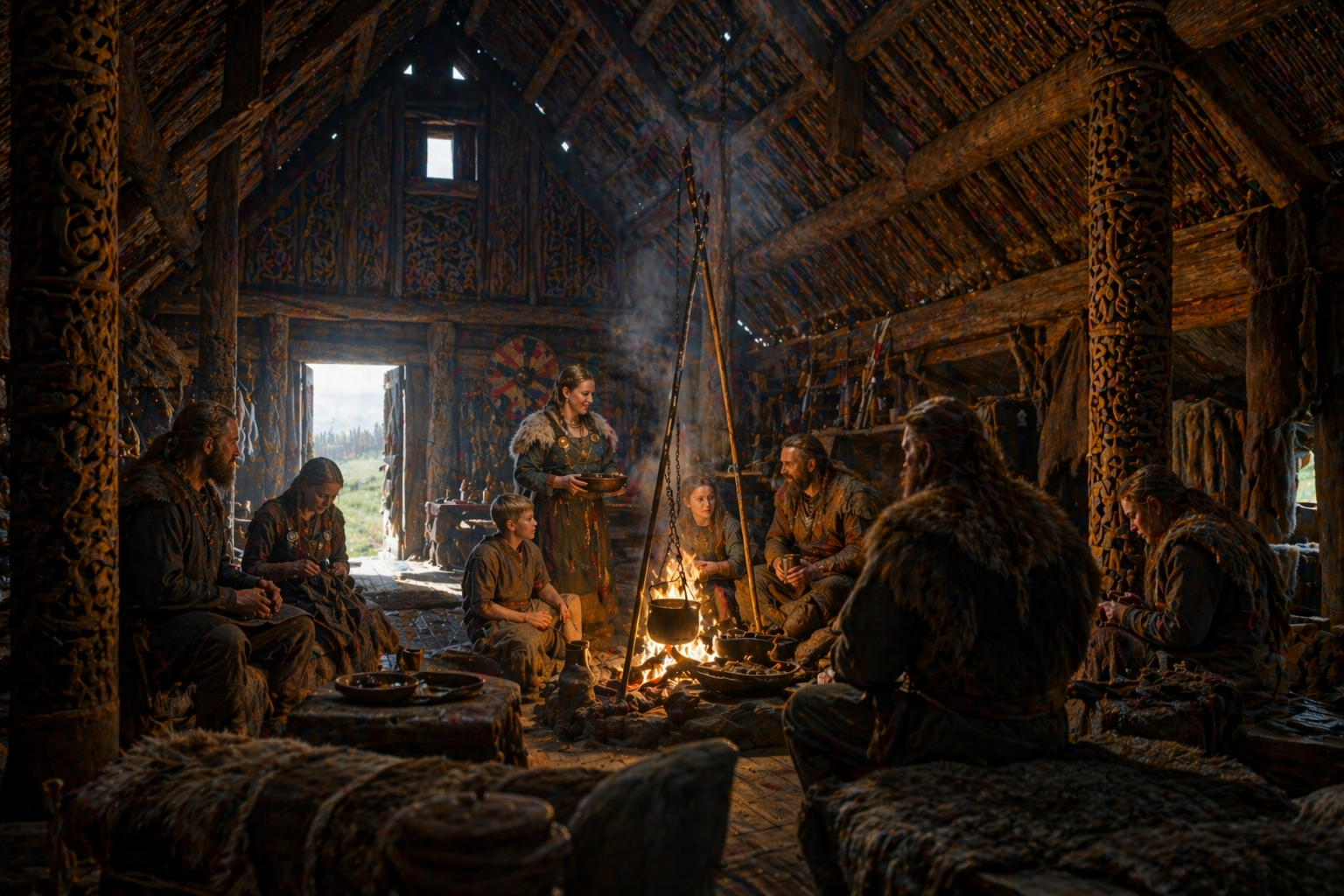
We see this in modern timber engineering, in flexible structural systems and in renewed interest in vernacular design principles. The past is not being copied, but it is being reconsidered.
Building With, Not Against
The idea that a building should move - even slightly - can feel counterintuitive. We associate movement with instability. With weakness, but the Viking longhouse challenges that assumption.
It suggests that stability is not always about standing still. It can be about moving in the right way, at the right time, for the right reasons.
Perhaps the most interesting lesson is this, is that the Vikings didn’t define strength as resistance - they defined it as survivability. A building that stands rigidly until it fails is not strong. A building that bends, adapts and endures is.
There is a tendency in construction to equate progress with adding more - more material, more strength, more complexity. But Viking longhouses remind us that sometimes, the smarter solution is not to add more, but to think differently.
To understand the forces at play. To design with them, not against them, because in the end, the buildings that last are not always the ones that fight hardest, they are the ones that know when to yield.
Frequently Asked Questions
1. How were Viking longhouses built?
Viking longhouses were constructed using timber frames with walls made from wattle and daub or turf. Their long, low-profile design and flexible timber structure helped them withstand strong winds and harsh Scandinavian weather.
2. Why were Viking buildings so resilient?
Viking buildings were resilient because they were designed to move with environmental forces rather than resist them completely. Flexible timber frames, lightweight roofs and natural materials allowed the structures to absorb wind loads without suffering significant damage.
3. Why did Viking longhouses bend instead of breaking?
The timber joints and natural building materials used in Viking longhouses allowed controlled movement. This flexibility reduced stress within the structure, helping buildings survive high winds and other environmental forces that might damage more rigid buildings.
4. What materials did Vikings use to build their homes?
Vikings primarily used locally available materials, including timber, turf, wattle, daub, reeds and thatch. These natural materials were durable, repairable and well suited to the climate of northern Europe.
5. Why is timber a good structural material?
Timber is naturally strong, lightweight and flexible. Unlike brittle materials, it can absorb and dissipate energy under load, making it highly effective in structures exposed to wind, vibration and even seismic activity.
6. What can modern construction learn from Viking architecture?
Modern construction can learn the importance of designing with environmental conditions rather than simply resisting them. Viking builders demonstrated how flexibility, simplicity and locally appropriate materials can create durable and resilient buildings.
7. Are flexible buildings stronger than rigid buildings?
Not always, but in many situations flexibility improves resilience. Buildings that can move slightly under wind or earthquake loads often experience lower stress levels than completely rigid structures, reducing the risk of structural failure.
8. Why were Viking longhouses long and narrow?
The long, narrow shape reduced wind resistance and helped direct airflow around the building. Combined with low-pitched roofs and curved walls, this design minimised wind pressure and improved structural stability.
9. What is vernacular architecture?
Vernacular architecture refers to buildings designed using local materials, traditional construction methods and knowledge developed in response to the local climate and environment. Viking longhouses are a classic example of vernacular design.
10. How does modern engineering use the same principles as Viking construction?
Modern engineers use flexibility in earthquake-resistant buildings, bridges, high-rise structures and timber buildings. Like Viking builders, they recognise that allowing controlled movement can improve structural performance and resilience.
11. Are timber buildings suitable for extreme weather?
Yes. Modern engineered timber buildings are designed to withstand strong winds, heavy snow and seismic forces. When properly designed and maintained, timber structures can provide excellent strength, durability and long-term performance.
12. Why is adaptability important in sustainable building design?
Adaptable buildings are often easier to repair, modify and extend, helping to reduce waste and extend their lifespan. Designing for flexibility rather than rigid permanence supports more sustainable construction over the long term.
Additional Articles
Who decided what a building should cost?
Every construction project begins with a question that can determine whether it proceeds at all - how much will it cost? Today, clients expect detailed cost estimates, contractors submit tenders...
Read moreThe History of Britain’s Indoor Plumbing Revolution
Today, flushing a toilet is one of the most unremarkable actions in modern life. We turn a handle or press a button, the waste disappears and we get on with our day. For most people in Britain,...
Read more
The 3,000-Year History of Scaffolding
The basic idea behind scaffolding is far older than steel, standardised fittings or modern health and safety. In fact, the first scaffolds were probably nothing more sophisticated than wooden poles...
Read more