
How early humans built shelters without tools
Long before cranes, concrete, or even the simplest hand tools, early humans were already addressing one of construction’s most fundamental challenges - how to create shelter using only what the environment could provide. This wasn’t construction as we understand it today, but it was far from primitive guesswork. These early shelters were the result of careful observation, repeated experience and an intuitive understanding of materials and conditions.
What stands out is not just that early humans built without tools, but that they built effectively. Their structures responded directly to climate, landscape and available resources. They were not designed on paper, but shaped by necessity and refined over generations.
Early humans did not begin with the intention to “build” in the modern sense. They began by recognising opportunity in their surroundings. Natural formations such as caves and rock overhangs provided immediate refuge from wind, rain and predators. These spaces required no alteration, yet they offered thermal stability and protection that would be difficult to replicate even with basic tools.
Research referenced by the Smithsonian Institution highlights how widespread the use of natural shelters was among early human groups. These environments offered a starting point, but they also imposed limitations. As populations moved, followed food sources, or adapted to changing climates, reliance on fixed natural shelters became impractical.
Mobility demanded flexibility. That need marked the transition from simply occupying shelter to actively creating it.
The First Structures: Branches, Bones and Instinct
Without cutting implements, early humans worked with materials that could be manipulated by hand or with minimal force. This shaped not only what they built with, but how they built.
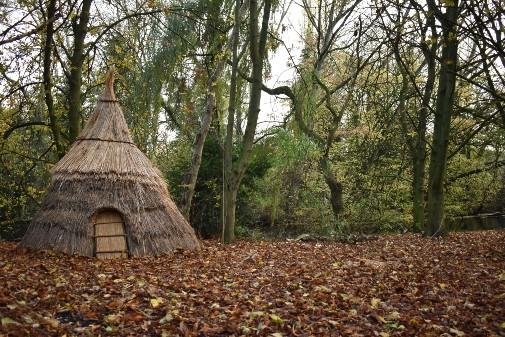
Branches were bent, leaned, and interwoven to form basic frames. These frameworks were not rigid in the modern sense, but they were stable enough to support coverings made from leaves, grasses, or animal hides. The process relied on tension and balance rather than precision joints or fixings.
In colder regions, where timber might be scarce, early humans adapted again. Archaeological evidence discussed by Encyclopaedia Britannica shows that mammoth bones were sometimes used as structural elements. These bones, arranged in circular or domed forms and covered with hides, created enclosed spaces capable of retaining heat.
These structures were rarely permanent. They were designed to be assembled, used and abandoned as needed. Their value lay in speed, efficiency, and the ability to respond to immediate environmental conditions.
Fire Changed Everything
The ability to control fire fundamentally altered how shelters were conceived and used. It extended the range of habitable environments and introduced new considerations into construction.
With fire, shelters could provide not just protection, but warmth. This allowed early humans to occupy colder regions and remain in one place for longer periods. However, it also introduced complexity. Fire required ventilation, safe spacing and careful positioning within a structure.
Evidence highlighted by the National Geographic Society suggests that early shelters began to incorporate openings for smoke release and were oriented to minimise wind exposure. Entrances were positioned strategically and internal layouts became more deliberate.
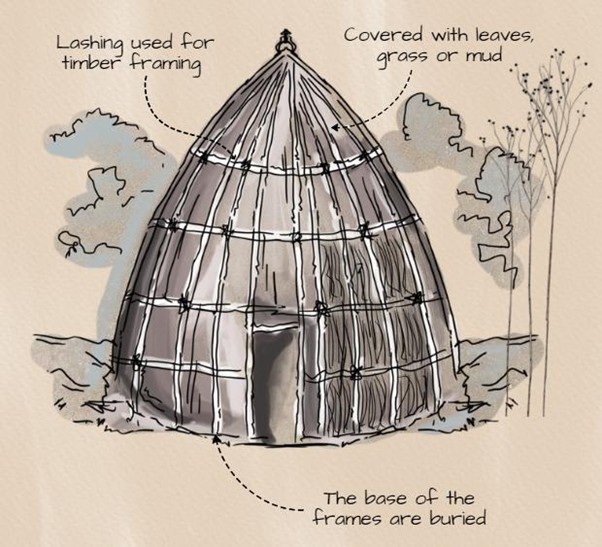
This marks an important change. Shelter was no longer just about covering space -it became about managing an internal environment. In many ways, this is one of the earliest examples of environmental design thinking.
Adapting to the Environment
There was no universal blueprint for early human shelters because there was no universal environment. Each structure was shaped by its surroundings.
In colder climates, shelters were compact and enclosed, using materials such as snow, bone and animal skins to retain heat. In forested regions, lightweight structures made from branches and foliage allowed for quick assembly and disassembly. In open landscapes, simple windbreaks provided enough protection to make exposure manageable.
Anthropological insights referenced by The British Museum emphasise that this adaptability was central to survival. Early humans did not attempt to impose uniform solutions across different landscapes. Instead, they adjusted their approach based on what was available and what was needed.
This responsiveness is a defining characteristic of early construction. It prioritised function over form and practicality over permanence.
Knowledge Without Tools
Perhaps the most remarkable aspect of these early shelters is not the materials used, but the knowledge behind them. Without written instructions, formal training, or measurement systems, early humans developed a working understanding of structure, materials and space.
They learned what would stand and what would collapse. They recognised which materials retained heat and which allowed it to escape. They understood how to position a shelter to reduce exposure to wind and maximise comfort.
This knowledge was not recorded, it was passed down through observation and repetition. Over time, it became embedded in practice. Each generation refined what the previous one had learned, gradually improving performance without ever formalising the process.
The Origins of Construction Thinking
Although these shelters were simple in form, they introduced principles that remain central to construction today. They established the importance of structural stability, environmental protection and thermal performance. They demonstrated that the success of a building depends not just on materials, but on how those materials are used and where they are placed.
Modern construction has developed far beyond these beginnings, incorporating advanced materials, digital design and precise engineering. Yet the underlying ideas remain the same. Buildings still need to stand, protect and perform within their environment. What has changed is the level of control, not the fundamental objective.
What We Can Learn Today
Looking back at how early humans built without tools offers a perspective that feels increasingly relevant. In an industry often driven by complexity, speed and technological advancement, these early approaches highlight the value of simplicity and understanding.
They show that effective construction starts with the environment, not the materials. They demonstrate that performance does not always require complexity and they remind us that adaptability is often more valuable than rigid planning.
At its core, construction has always been about solving problems with the resources available. That was true then and it remains true now.
Early humans built shelters with their hands, their surroundings and their instincts. There were no drawings, no specifications and no machinery, only necessity and the ability to respond to it.
Those early structures may not have lasted, but the thinking behind them did and in many ways, that thinking still defines construction today.
Additional Articles
Who decided what a building should cost?
Every construction project begins with a question that can determine whether it proceeds at all - how much will it cost? Today, clients expect detailed cost estimates, contractors submit tenders...
Read moreThe History of Britain’s Indoor Plumbing Revolution
Today, flushing a toilet is one of the most unremarkable actions in modern life. We turn a handle or press a button, the waste disappears and we get on with our day. For most people in Britain,...
Read more
The 3,000-Year History of Scaffolding
The basic idea behind scaffolding is far older than steel, standardised fittings or modern health and safety. In fact, the first scaffolds were probably nothing more sophisticated than wooden poles...
Read more