
What ancient builders knew about trust, risk and responsibility
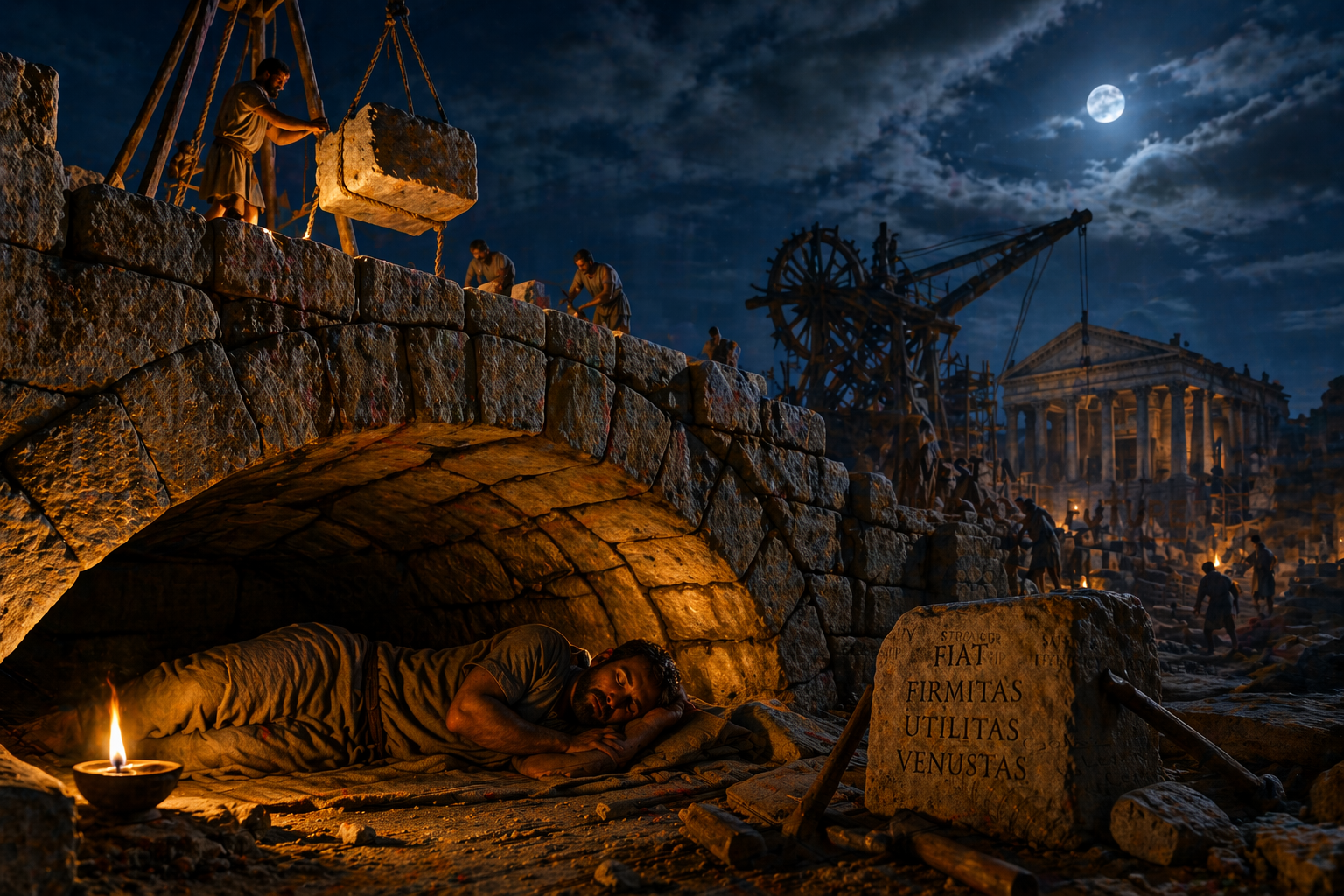
It sounds almost absurd by modern standards, but before a structure was signed off, before it was declared safe or complete, the builder would sleep beneath it overnight. No certificates. No warranties. No third-party approvals. Just a simple, unfiltered question - would you trust your own work with your life?
This idea appears in various forms across ancient and early construction cultures. While not universally documented as a formal rule, historical accounts and construction traditions suggest that master builders often took personal responsibility for their work in ways that feel almost alien today.
In some regions, particularly in parts of the Middle East and Asia, there are references to builders remaining beneath newly completed structures to demonstrate confidence in their integrity according to International Journal of Architectural Heritage.
However, whether literal or symbolic, the message is clear. Accountability was personal and it was immediate.
A Different Kind of Quality Assurance
Today, construction is governed by layers of regulation, inspection and compliance. In the UK, frameworks such as those set out by the Health and Safety Executive and building control bodies ensure that safety is assessed through process, documentation and verification.
That system exists for good reason. Modern buildings are more complex, more regulated and involve far more stakeholders than ever before, but in ancient construction, quality assurance looked very different.
There were no standardised codes. No digital models. No sign-off meetings. What existed instead was craft knowledge, reputation and consequence.
In ancient Mesopotamia, for example, the Code of Hammurabi (circa 1754 BC) made this brutally explicit. Law 229 states that if a builder constructed a house that collapsed and caused the death of the owner, the builder could be put to death. If it killed the owner’s son, the builder’s son could be executed.
Extreme, by any measure, but it underlines a principle that responsibility sat firmly with the person who built it. Sleeping under a structure, then, wasn’t just theatre. It was a visible expression of confidence - or perhaps necessity - in a world where failure carried immediate and severe consequences.
Trust Built Into the Process
What’s striking about this idea is not just the act itself, but what it represents. Modern construction separates responsibility across disciplines. Designers design. Contractors build. Inspectors inspect. Clients approve. Liability is distributed, often contractually, across multiple parties. Ancient construction was far more integrated.
The “builder” was often designer, engineer and craftsman in one. Knowledge was passed down through apprenticeship, not documentation. Decisions were made on site, based on experience rather than models.
According to the Encyclopaedia Britannica, many ancient structures, from Egyptian temples to Roman infrastructure, were delivered through highly skilled labour forces led by master builders who held both technical authority and practical responsibility.
That combination changes behaviour. When you design it, build it and stand beneath it, your relationship with risk is very different.
The Role of Experience Over Calculation
It would be easy to assume that ancient builders were simply less advanced, relying on instinct where we now use engineering science, but that misses something important.
Many ancient structures have outlasted modern equivalents by centuries, even millennia. The Pantheon in Rome, completed around 126 AD, still holds the world’s largest unreinforced concrete dome. Roman roads continue to influence infrastructure design today. Stone structures from the Inca civilisation remain standing in seismic zones where modern buildings have failed.
According to research highlighted by the American Society of Civil Engineers, the durability of ancient construction often came from over-engineering, material understanding and iterative learning over generations.
They didn’t have finite element analysis, but they had something else, a deep familiarity with materials and behaviour. Sleeping under a structure was not guesswork. It was a final, personal validation built on years - often decades - of accumulated knowledge.
What Changed?
So why did we move away from this kind of thinking? The answer lies in scale and complexity.
Modern construction involves vast supply chains, advanced materials, regulatory frameworks and multidisciplinary teams. No single individual can realistically hold complete responsibility for a project in the way ancient builders did. We replaced personal accountability with systems.
Standards, certifications and inspections are designed to reduce risk systematically rather than individually. Organisations such as the Chartered Institute of Building emphasise structured processes, risk management and professional standards as the foundation of modern construction practice - and again, this is necessary, but something has been lost in the transition.
The Distance Between Decision and Consequence
One of the unintended consequences of modern construction is distance. Distance between design and delivery. Distance between decision and outcome and distance between responsibility and consequence.
When problems occur, they are often the result of small decisions made across multiple stages. Rarely is there a single point of failure. More often, it is a chain of assumptions, miscommunications or compromises. This is not about blame. It is about structure.
In a system where responsibility is distributed, it can also become diluted. The ancient idea of sleeping under a structure removes that distance entirely. It compresses responsibility into a single moment - if it fails, it fails on you.
No one is suggesting we bring this practice back literally, but it raises an interesting question. What would change if we approached modern construction with the same mindset?
Not sleeping under buildings, but asking:
- Would I be comfortable putting my name and reputation against this decision?
- Do I fully understand how this detail will be built, not just how it is drawn?
- Am I confident in the materials, sequencing and workmanship behind this element?
Because in many cases, issues in construction do not come from a lack of knowledge. They come from assumptions made under pressure. Time constraints. Budget pressures. Programme demands. These are modern realities, but they can also create distance between what we know is right and what we deliver.
Confidence vs Compliance
There is a difference between compliance and confidence. A project can meet every regulatory requirement and still feel uncertain to those delivering it. Equally, a well-understood, well-executed piece of work can feel inherently “right,” even before it is formally signed off.
Ancient builders operated almost entirely in the realm of confidence, built through experience, repetition and direct accountability. Modern construction operates largely in the realm of compliance, built through systems, documentation and verification. The best outcomes likely sit somewhere between the two
What This Means for the Industry
The idea of sleeping under a structure is not about nostalgia. It is about perspective. It reminds us that construction, at its core, is not just a technical process. It is a human one. It is about judgement, responsibility and trust.
As the industry continues to evolve, with digital tools, automation and increasingly complex systems, there is a risk that the human connection to what we build becomes more abstract.
But buildings are not abstract. People live in them. Work in them. Trust them and perhaps that is the enduring lesson. It’s a simple question. Slightly uncomfortable. Slightly provocative, but also revealing. Because behind every drawing, every specification and every programme is a real-world outcome.
Ancient builders may not have had our tools or technology. But they understood something fundamental, that confidence in construction is not created at completion - it is built into every decision along the way.
And sometimes, the best test of that confidence is the simplest one. Would you trust it enough to sleep under it?
Additional Articles
The 3,000-Year History of Scaffolding
The basic idea behind scaffolding is far older than steel, standardised fittings or modern health and safety. In fact, the first scaffolds were probably nothing more sophisticated than wooden poles...
Read moreThe Victorian ventilation revolution and what we forgot
Long before air conditioning, Victorian architects were designing buildings around a problem that has returned with a vengeance. How do you keep large, crowded buildings supplied with fresh air...
Read more

Why Georgian houses have surprisingly thin walls
Walk into a Georgian townhouse and the proportions can feel almost impossibly elegant. Tall windows, narrow façades and beautifully ordered brickwork give the impression of lightness. Yet behind that...
Read more