
How ancient builders used optical illusions to perfect structures
Stand in front of a great ancient structure such as a Greek temple, a Roman road, or a monumental staircase and everything feels precise. Lines look straight. Columns appear perfectly vertical. Surfaces feel balanced and harmonious, but look a little closer and something surprising emerges. Many of these structures are not actually straight at all.
They were deliberately designed with subtle curves, inclines and adjustments - optical illusions built into the fabric of the construction. Not mistakes. Not imperfections, but intentional corrections.
The issue ancient builders faced is one we still encounter today: True straight lines don’t always look straight to the human eye. If you build a perfectly flat horizontal surface, it can appear to sag in the middle. A perfectly straight column can look thinner at the centre. Long vertical lines can seem to bow outward. This is not a flaw in the structure. It’s a characteristic of human perception.
Ancient builders understood this, not through formal optics or visual science, but through observation and experience and instead of ignoring it, they designed around it.
The Parthenon: A Masterclass in Illusion
Perhaps the most famous example is the Parthenon in Athens. To the naked eye, it appears to be a model of perfect symmetry and straight lines. In reality, it is anything but.
According to studies referenced by the Encyclopaedia Britannica, the Parthenon incorporates a series of subtle refinements:
- The stylobate (the platform the columns sit on) is slightly curved upward in the centre
- The columns are not perfectly straight — they have a slight bulge known as entasis
- Corner columns are thicker than those in the middle
- Columns lean inward slightly rather than standing perfectly vertical
These adjustments are incredibly small, often measured in millimetres, but they have a profound visual effect. Without them, the building would look distorted. With them, it appears perfectly proportioned.
Entasis: The Curve That Tricks the Eye
The concept of entasis is one of the clearest examples of this thinking. A completely straight column can appear concave to the human eye, as though it is narrowing in the middle. To counter this, Greek builders introduced a slight outward curve. The result? The column appears straight, even though it isn’t.
Research from the American Institute of Architects highlights how these refinements were critical in achieving the visual harmony associated with classical architecture. It wasn’t about mathematical perfection. It was about perceived perfection.
Beyond Greece: A Widespread Practice
This wasn’t limited to Greek temples. Across different cultures and time periods, builders applied similar principles. Roman roads, for example, were often constructed with a slight camber, a gentle curve across the surface, to aid drainage. This also created a visual sense of structure and intention.
Medieval cathedrals incorporated vertical adjustments to towers and walls to counter the appearance of leaning or instability. Even in ancient Egypt, there is evidence that pyramid faces were not perfectly flat, but subtly adjusted to improve visual uniformity under changing light conditions.
According to research discussed by the Smithsonian Institution, these kinds of refinements demonstrate a sophisticated understanding of how humans perceive space and form.
Designing for the Human Eye, Not Just the Drawing
What makes this so interesting is the mindset behind it. Ancient builders were not chasing geometric perfection in isolation. They were designing for how buildings are experienced, not just how they are measured.
Modern construction, by contrast, often prioritises precision in terms of dimensions, tolerances and alignment. Digital tools allow us to achieve near-perfect accuracy, but accuracy and perception are not the same thing.
A perfectly level surface can still look wrong. A perfectly straight line can still feel off. Ancient builders understood that the end user is not a measuring instrument. They are a human being.
This raises an uncomfortable question. In striving for technical perfection, have we sometimes overlooked visual or experiential quality? Modern construction relies heavily on drawings, models and specifications. These are essential tools, but they represent an abstract version of reality.
On site, things behave differently. Light changes. Angles shift. Materials interact. People move through spaces. Ancient builders worked almost entirely in this physical, real-world context. Their adjustments were made based on what they saw, not just what they planned.
A Different Kind of Skill
It’s easy to underestimate the skill required to achieve these effects. Creating optical corrections is far more demanding than building something “perfectly straight.” It requires judgement, experience and a deep understanding of proportion. There is no simple formula.
Each adjustment must be subtle enough to remain invisible, yet effective enough to influence perception. That balance is difficult to achieve, even with modern tools.
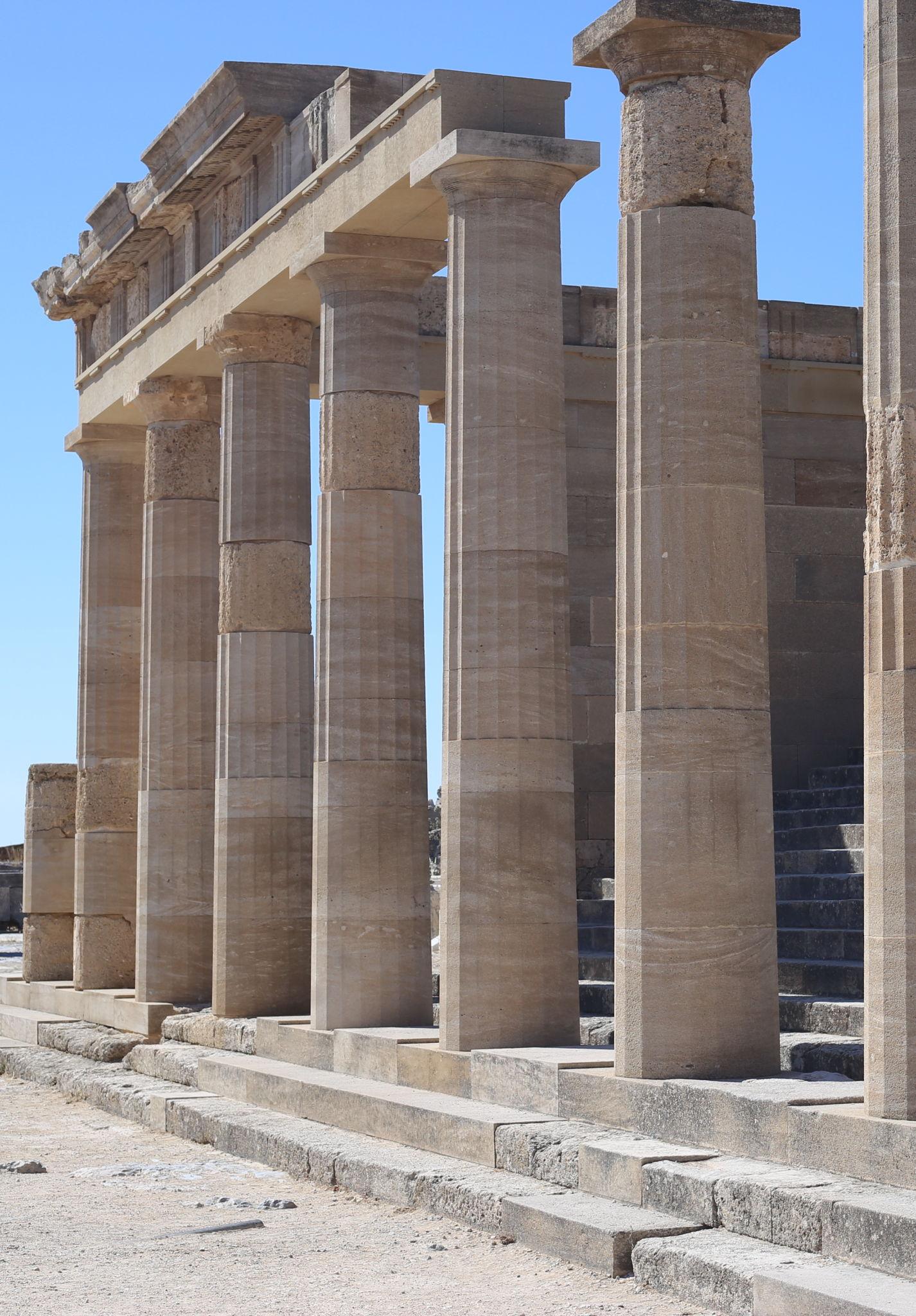
The use of optical illusions in ancient construction is not just a historical curiosity. It offers a practical lesson. Buildings are not experienced as drawings. They are experienced as spaces and that experience is shaped as much by perception as by precision.
This has implications for:
- Architectural design
- Detailing and finishing
- Material selection
- Lighting and spatial composition
It suggests that the final judgement of a building is not whether it meets a specification, but whether it feels right.
Where We Still Use This Thinking
Interestingly, this approach hasn’t disappeared entirely. Modern architecture and product design still use optical corrections. Typography, for example, uses subtle adjustments to make letters appear balanced. Car design incorporates curves that are not symmetrical but look it. Even digital interfaces are designed with visual weighting rather than strict geometry.
In construction, however, this thinking is less visible. The focus is often on compliance, tolerance and measurable accuracy - all essential, but not always sufficient.
Ancient builders didn’t have laser levels, CAD software or digital models, but they had something just as valuable - an understanding of how people see. They recognised that reality and perception are not the same thing and they built accordingly.
The result is structures that still feel “right” thousands of years later, not because they are perfectly straight, but because they were never meant to be. Sometimes, the straightest line is the one that isn’t.
Frequently Asked Questions
1. Why aren't the columns of the Parthenon perfectly straight?
The Parthenon's columns were deliberately designed with a slight outward curve called entasis. This optical correction prevents the columns from appearing thinner in the middle, making them look perfectly straight to the human eye.
2. What is entasis in architecture?
Entasis is a subtle outward curve built into a column to counteract the optical illusion that perfectly straight columns appear to narrow at their centre. It was widely used in ancient Greek architecture to improve visual balance.
3. Why did ancient builders use optical illusions in construction?
Ancient builders understood that the human eye does not always perceive straight lines accurately. They introduced subtle curves and adjustments so buildings appeared visually balanced and harmonious rather than mathematically perfect.
4. What optical illusions were built into the Parthenon?
The Parthenon incorporates several visual refinements, including a gently curved platform (stylobate), columns with entasis, thicker corner columns and columns that lean slightly inward. Together, these features create the illusion of perfect symmetry.
5. What is the stylobate on a Greek temple?
The stylobate is the upper platform on which the columns of a Greek temple stand. On the Parthenon, it is slightly curved upwards in the centre to prevent it from appearing to sag when viewed from a distance.
6. Did the Romans also use optical corrections in construction?
Yes. Roman engineers frequently used subtle design adjustments, including cambered roads to improve drainage and visual appearance. Many Roman buildings also incorporated refinements that enhanced their perceived symmetry and stability.
7. How do optical illusions influence architecture?
Optical illusions affect how people perceive height, width, straightness and proportion. Architects often use subtle adjustments to make buildings appear more balanced, elegant and visually pleasing.
8. Are optical corrections still used in modern architecture?
Yes. Modern architects, designers and engineers continue to use optical corrections in buildings, furniture, typography, vehicle design and digital interfaces to improve visual balance and user experience.
9. Why can perfectly straight lines look curved?
Human vision naturally distorts long horizontal and vertical lines. Depending on lighting, distance and perspective, perfectly straight surfaces can appear to sag, bow or taper, which is why architects sometimes introduce subtle visual corrections.
10. What can modern construction learn from ancient builders?
Ancient builders remind us that successful buildings are judged not only by technical accuracy but also by how they are experienced. Designing for human perception is just as important as meeting precise engineering tolerances.
11. Did ancient builders understand visual perception?
Although they did not have modern scientific knowledge of optics, ancient builders developed a remarkable understanding of visual perception through observation and experience, using it to create some of history's most admired buildings.
12. Why is the Parthenon still considered an engineering masterpiece?
The Parthenon combines extraordinary craftsmanship with sophisticated structural engineering and subtle optical refinements. Its carefully calculated curves and proportions have helped it remain one of the world's most influential architectural achievements for over 2,400 years.

Additional Articles
Who decided what a building should cost?
Every construction project begins with a question that can determine whether it proceeds at all - how much will it cost? Today, clients expect detailed cost estimates, contractors submit tenders...
Read moreThe History of Britain’s Indoor Plumbing Revolution
Today, flushing a toilet is one of the most unremarkable actions in modern life. We turn a handle or press a button, the waste disappears and we get on with our day. For most people in Britain,...
Read more
The 3,000-Year History of Scaffolding
The basic idea behind scaffolding is far older than steel, standardised fittings or modern health and safety. In fact, the first scaffolds were probably nothing more sophisticated than wooden poles...
Read more