
What does a building look like from the back of a van?
Look at a construction project from the architect's perspective and you will see drawings, elevations, specifications and carefully coordinated details. Look at it from the contractor's perspective and you see programmes, trades, plant and sequencing, but look at it from the back of a delivery van and you see something completely different, writes John Ridgeway.
You see how big everything is, how well it is packaged, what can be damaged, what needs to stay dry, how much space it takes up, how it will be unloaded and most importantly, how anyone is going to get it from the road to where it needs to be installed. That perspective is becoming increasingly important as construction sites become more constrained and buildings become more complicated.
A construction component doesn't magically appear at its point of installation. Before it reaches the site, somebody has had to manufacture it, package it, load it, transport it and unload it. That sounds obvious. Yet logistics can sometimes be treated as something that happens around construction rather than something that is integral to it.
Consider a large prefabricated component. It may have been designed to fit perfectly into the building, but can it fit through the site entrance? Can the delivery vehicle reach the site? Can the component be unloaded safely? Is there somewhere to put it? Can it be moved from the unloading point to its final location and what happens if the answer to any of those questions is no?
The problem isn't necessarily with the product. The problem is that nobody considered the journey.
Packaging is part of construction
Packaging is rarely the most exciting part of a construction project, but it can have a surprisingly significant impact. A component that arrives well protected is less likely to be damaged, but protection takes space.
A product may be compact when manufactured, but considerably larger once it has been packaged for transport. Materials may need to remain dry. Fragile components may require additional protection. Long or awkwardly shaped products may need specialist vehicles.
Then there is the question of what happens to the packaging once it reaches site. Where does it go? Who removes it? How is it stored? How much waste does it create? These questions become particularly important on urban projects where there may be almost no spare space.
The site that has nowhere to put anything
One of the biggest logistical challenges facing modern construction is space. Many projects are being built on tight urban sites surrounded by existing buildings, roads, pedestrians and neighbouring businesses.
There may be no large storage yard. There may be limited vehicle access. There may be strict delivery windows. There may also be nowhere to leave materials overnight. The result is that construction increasingly has to operate almost like a just-in-time manufacturing process.
Materials arrive when they are needed, are unloaded, moved into position and installed. That can be extremely efficient when everything works, but it also makes the project more vulnerable when something goes wrong. A delayed delivery isn't simply an inconvenience if the site has no alternative stock.
The last 50 metres
Perhaps the most overlooked part of construction logistics is the distance between the delivery vehicle and the point of installation. A lorry can successfully reach the site. The materials can be unloaded, but now somebody has to move them.
That might involve a telehandler, crane, hoist, trolley, pallet truck or several people physically carrying components. The final 50 metres can therefore be every bit as important as the first 500 miles.
Can a pallet fit through the entrance? Is there sufficient turning space? Can materials reach an upper floor? Is the lift large enough? Can a component pass through a doorway? Does the route contain steps, ramps or narrow corridors? These are practical questions, but they can have major implications for programme, labour and safety.
What happens when the component is too big?
The construction industry has become increasingly interested in prefabrication and off-site manufacturing because of the potential benefits in quality, productivity and programme. But the more construction moves towards larger preassembled components, the more important logistics becomes.
A component can be perfectly designed and manufactured but still create problems if it cannot be transported or manoeuvred into position. This is where design and logistics need to meet much earlier. Instead of asking only - "Can we manufacture this?" - we should also be asking: "Can we deliver it?" And - "Can we install it?"
Designing for delivery
This doesn't mean architects and engineers suddenly need to become logistics specialists. It means logistics needs to become part of the conversation much earlier. The dimensions of components, delivery vehicles, access routes, lifting requirements and storage arrangements can all influence whether a construction method is practical.
Digital modelling can help teams visualise routes and identify potential clashes before materials arrive.
Manufacturers can also play an important role by considering how products are packaged, handled and transported – and not how they perform once installed. The best product on paper isn't necessarily the best product for a particular project if getting it into the building creates an unnecessary logistical challenge.
When deliveries become a safety issue
Logistics is not just about efficiency. It is also about safety. Every additional movement of materials creates an opportunity for something to go wrong.
Poorly planned unloading areas can create conflicts between vehicles and pedestrians. Materials stored in inappropriate locations can obstruct routes. Manual handling of heavy or awkward components can increase the risk of injury.
Good logistics planning can therefore remove risks before work begins. A delivery should not answer the question "When will it arrive?" It should also answer - where will it go? Who will unload it? How will it be moved? Where will it be stored? How will it reach the point of installation? Perhaps then, we need to design buildings from the back of the van
The construction industry is rightly obsessed with design. We debate aesthetics, structural efficiency, energy performance, embodied carbon and building performance, but perhaps we should occasionally look at a building from a completely different perspective.
Maybe we should stand at the back of the delivery vehicle. Look at the component sitting inside it. Then ask - how is this going to become part of the building?
That simple question can reveal an extraordinary number of issues that aren't obvious from a drawing. Because a building is not a collection of components assembled on a site. It is a flow of materials, people, information and equipment moving through a constrained environment.
When that flow works, construction can appear remarkably simple. When it doesn't, a single delivery can stop an entire site. And perhaps that is why the next great construction efficiency isn't necessarily going to come from building something faster. It may come from getting it to the right place in the first place.
Frequently Asked Questions
1. Why is construction logistics important?
Construction logistics determines how materials, equipment and components reach the site, are unloaded, stored and moved into position. Poor planning can cause delays, additional labour costs, safety risks and disruption.
2. What does construction logistics involve?
It covers everything from delivery scheduling and vehicle access to unloading, storage, lifting, internal movement, waste management and getting materials to their final installation point.
3. Why can urban construction sites be difficult to supply?
Urban sites often have restricted access, limited storage space, busy roads, neighbouring properties and strict delivery windows. These constraints make careful planning essential.
4. What is just-in-time delivery in construction?
Just-in-time delivery means materials arrive shortly before they are needed rather than being stored on site for long periods. It can reduce storage requirements but leaves less room for delays or missed deliveries.
5. Why is packaging important in construction logistics?
Packaging protects products during transportation and handling but also affects their overall size, weight and storage requirements. Excessive or unsuitable packaging can create additional logistical and waste-management challenges.
6. What is the importance of the "last 50 metres" on a construction site?
The final movement from the delivery vehicle to the installation point can be surprisingly difficult. Materials may need to pass through entrances, corridors, lifts or restricted areas, sometimes requiring specialist lifting or handling equipment.
7. How can poor construction logistics cause project delays?
A delayed or incorrectly planned delivery can prevent trades from starting work, particularly where there is little on-site storage or no alternative material available. One logistical problem can therefore affect an entire programme.
8. How does construction logistics affect site safety?
Poorly planned deliveries can create conflicts between vehicles, pedestrians and site workers. Inadequate storage and unnecessary material handling can also increase manual-handling and access risks.
9. How can prefabrication affect construction logistics?
Prefabricated and preassembled components can improve productivity, but their size, weight and handling requirements must be considered. A component needs to be transportable and capable of being safely moved into its final position.
10. Should logistics be considered during building design?
Yes. Component dimensions, delivery routes, lifting requirements, vehicle access and storage should be considered early enough to influence design and construction methods rather than being solved once work has started.
11. Can BIM and digital modelling improve construction logistics?
Digital models can help teams visualise access routes, identify potential constraints and plan the movement and positioning of components before they arrive on site. This can help identify logistical problems earlier.
12. How can construction companies improve site logistics?
Start planning logistics early, understand site constraints, coordinate deliveries, establish clear unloading and storage areas, consider the movement of materials to their final location and involve suppliers, contractors and logistics teams in the planning process.
Additional Blogs
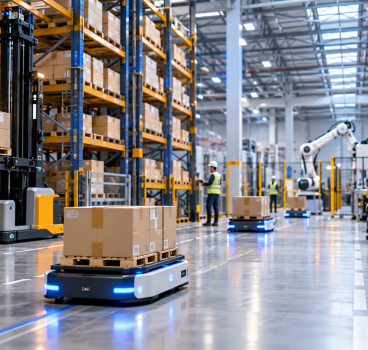
The Robotics as a Service Revolution Is Reshaping Warehouse Infrastructure Requirements
Warehouse operators now rent automation equipment instead of purchasing it outright. These robotics as a service models provide access to advanced machines without major capital investments. As...
Read moreIs construction becoming brilliant at measuring everything except common sense
Construction has never had access to more information. We can track the progress of a project almost in real time. We can monitor costs, labour, productivity, programme performance, carbon, waste,...
Read more

Rewilding construction sites to boost local biodiversity
At a time when the UK is facing a serious decline in wildlife, the construction industry has an opportunity to rethink its relationship with the natural environment. So let’s ask the question - could...
Read more