
Who Is responsible for safety when everyone Is responsible?
When something goes wrong on a construction site, there is a natural temptation to find one person to blame. The worker who made the mistake, the subcontractor who failed to follow the method statement, the site manager who should have spotted it, the principal contractor who was responsible for the site, the designer who created the detail or perhaps the client who insisted on the programme. The reality is usually more complicated, because construction safety is deliberately built around shared responsibility, writes John Ridgeway.
Under the Construction (Design and Management) Regulations 2015, virtually everyone involved in a construction project has duties relating to health and safety. Clients, designers, principal designers, principal contractors, contractors and workers all have defined responsibilities, while organisations and individuals can sometimes hold more than one duty holder role.
That sounds sensible, but it is also where an uncomfortable question begins. If everyone is responsible, who is actually responsible? The distinction matters because a culture of shared responsibility can either create a genuinely safer project or become a convenient way of making responsibility feel diluted.
A worker has a responsibility to take reasonable care of their own health and safety and that of others, to cooperate with other duty holders and to report anything that could endanger people. That does not mean, however, that a worker standing at the bottom of a hierarchy carries the same responsibility as the people who designed the work, set the programme, selected the contractor or controlled the site.
The same principle applies further up the chain. A subcontractor has responsibilities for the work under its control. The principal contractor has responsibility for planning, managing, monitoring and coordinating the construction phase. The principal designer has responsibilities during pre-construction, including coordinating design work and ensuring foreseeable risks are eliminated, reduced or controlled where possible. The client has perhaps the most fundamental influence of all because decisions about time, resources, procurement and the project team can shape the conditions in which everyone else is expected to work. So, responsibility is shared, but it is not necessarily equal.
The problem often starts before anyone reaches site
One of the most important aspects of CDM is that health and safety does not begin when the first person walks through the site entrance. A design decision can create a risk that a contractor has to manage months later. A procurement decision can determine which materials and systems are available. A programme can create pressure that affects sequencing. Incomplete information can force decisions to be made under pressure. A client can establish expectations about cost and completion that influence every subsequent decision.
The HSE specifically recognises the client's influence over a project, including the appointment of designers and contractors and the time, money and resources made available. It also identifies the principal designer's role in influencing risks through decisions made during the pre-construction phase. That is why it is too simplistic to look at an incident on site and ask only, “Who was holding the tool?” The more useful question might be: “What decisions led to this person being in this situation?”
The worker is often the last link in the chain
Imagine a worker carrying out a task that has become unsafe. Perhaps the access is awkward. Perhaps the sequence has changed. Perhaps the specified equipment isn't available. Perhaps another trade has created an obstruction. Perhaps the original method simply doesn't work in the conditions that now exist. The worker may make a poor decision, but what happened before that decision?
Was the risk identified during design? Was the method properly planned? Was the information communicated? Was the subcontractor given enough time? Was the site adequately coordinated? Was the change in circumstances recognised? Did anyone listen when the worker raised a concern?
The individual decision still matters, but it may only be the final link in a much longer chain. That is why simply telling workers to “work safely” is never enough. People need the conditions in which working safely is actually possible.
The principal contractor has a particularly important role because they control the construction phase on projects involving more than one contractor. Their duties include planning, managing, monitoring and coordinating the construction phase, ensuring appropriate inductions and training, coordinating contractors and consulting workers, but that does not make the principal contractor responsible for every decision made by every organisation and individual on a project.
A subcontractor remains responsible for planning, managing and monitoring the work under its control. A designer remains responsible for the risks associated with the designs they prepare or modify. Workers have their own responsibilities. The system is intended to work through cooperation rather than through one organisation carrying every safety obligation.
The danger comes when “shared responsibility” becomes an excuse for nobody taking ownership. If a risk sits between two organisations, who owns it? If a design creates a construction problem, who challenges it? If a subcontractor identifies a problem with sequencing, who has the authority to change the programme? If a worker says the method is unsafe, who actually has the responsibility to stop and reconsider it? Those are the questions that matter.
Paperwork can create the illusion of control
Construction has no shortage of risk assessments, method statements, permits, inductions, inspection records and signatures. All of these can be valuable, but paperwork is not the same thing as control.
A beautifully completed risk assessment cannot make an unsafe activity safe. A signed briefing cannot prove that somebody understood it. A method statement cannot anticipate every condition that will exist on site and an induction cannot compensate for poor planning. The real test is what happens when circumstances change.
Does somebody have the confidence and authority to stop the activity? Does the management team listen? Can the programme accommodate a change? Can the subcontractor challenge the principal contractor? Can the worker say, “This isn't safe,” without being labelled difficult? That is where safety culture becomes real. So, who is responsible? The answer is uncomfortable because there isn't one person.
That means communicating. Challenging. Sharing information. Raising concerns. Listening to people who actually carry out the work. Revisiting decisions when circumstances change. The strongest safety culture is therefore not one in which everyone is constantly asking, “Is this my responsibility?”
It is one in which people ask: “Is someone dealing with this, and if not, what am I going to do about it?” Because on a construction project, responsibility may be shared, but accountability should never disappear into the gaps between the people who share it.
Frequently Asked Questions
1. Who is ultimately responsible for health and safety on a construction project?
There is rarely one person who carries all responsibility. Under CDM 2015, different duty holders have specific responsibilities, including the client, designers, principal designer, principal contractor, contractors and workers. The important point is that shared responsibility must not become an excuse for nobody taking ownership of a risk.
2. Does the principal contractor carry responsibility for everything that happens on site?
No. The principal contractor has important responsibilities for planning, managing, monitoring and coordinating the construction phase, but contractors remain responsible for the work under their control. Responsibility depends on the particular risk, activity and duty holder involved.
3. Can a worker be blamed if they ignore a safety procedure?
Workers have responsibilities, including taking reasonable care of their own health and safety and that of others who could be affected by their actions. However, an incident should not automatically be reduced to individual error. Investigating why the decision was made can reveal problems with training, supervision, equipment, planning or working conditions.
4. What responsibility does the client have for construction safety?
Clients have significant influence over health and safety because their decisions can affect the appointment of designers and contractors, project resources, programme and overall arrangements. They must make suitable arrangements for managing a project and ensure appropriate duty holders are appointed.
5. Can a designer be responsible for a construction accident?
Potentially, yes. Designers have duties to eliminate, reduce or control foreseeable risks arising from their designs where reasonably practicable. A construction problem can sometimes originate from a design decision made long before work begins on site.
6. What happens when a subcontractor identifies a safety problem?
The subcontractor should raise the issue through the appropriate management arrangements and take appropriate steps to prevent people being exposed to the risk. A good project should make it possible for subcontractors to challenge unsafe conditions without fear that raising concerns will damage commercial relationships.
7. Who is responsible when a risk falls between two contractors?
This is precisely where clear communication and coordination become important. Each duty holder should understand the work they control and how it interacts with others. Where responsibility is unclear, the risk should be escalated rather than simply passed between organisations.
8. Is having a risk assessment and method statement enough?
No. Risk assessments and method statements are important tools, but they only contribute to safety when they accurately reflect the work being undertaken and are understood and followed. Conditions can also change, meaning the planned controls may need to be reviewed.
9. Who can stop unsafe work on a construction site?
Anyone who identifies an immediate and serious danger should raise the concern, and organisations should have arrangements that allow unsafe work to be stopped and reassessed. The precise authority to stop work will depend on the project's management arrangements, but a strong safety culture should never discourage someone from speaking up.
10. Does shared responsibility make it harder to establish accountability?
It can if responsibilities are poorly defined or people assume that somebody else is dealing with a problem. Properly implemented, however, shared responsibility should do the opposite by ensuring risks are considered at different stages of a project and by different people with relevant knowledge.
11. Why should construction safety be considered during design?
Some risks can be eliminated or reduced before construction begins, when changes are generally easier and less expensive to make. Designers and other pre-construction duty holders can therefore have a major influence on the risks that workers will encounter later.
12. What is the biggest mistake organisations make about safety responsibility?
Perhaps the biggest mistake is confusing having responsibility with taking ownership. A project can have every duty holder correctly identified and still have poor safety if nobody feels responsible for acting when something falls outside the original plan. Good safety management depends on people communicating, challenging decisions and responding when circumstances change.
Additional Blogs
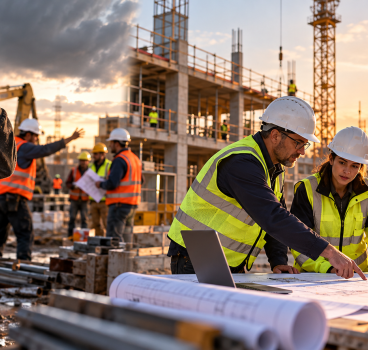
How to Take Your Team from Reactive Problem-Solving to Proactive Planning
Many jobsites rely on reacting to issues as they appear, leading to costly fixes and avoidable delays. Shifting to a forward-planned environment, where all trades work from a shared plan, helps teams...
Read moreDesigning with large trees and how architects can create immediate impact
Architecture is often judged by the relationship between buildings and their surroundings, but even an exceptional building can feel unfinished when it sits within a landscape of young trees, exposed...
Read more
The numbers don’t lie: why industrial fire statistics demand a response
Every year the government publishes its fire statistics, and every year those of us in the fire safety sector read them with a mixture of curiosity and concern. Curiosity, because they represent an...
Read more