
Warehouses – 20 years on: Have we run out of road?
Twenty years ago, a piece of regulatory guidance quietly set a ceiling, quite literally, on what a warehouse could be without sprinklers. That 18 metre height limit in Approved Document B was, at the time, an outer boundary to signal a building that was going taller than perhaps the norm. Two decades on, warehouses look very different. The question is whether our thinking about protecting them has kept pace, writes Tom Roche, Secretary of the Business Sprinkler Alliance.
I wrote recently about the sky's the limit mentality driving speculative warehouse development. Buildings pushing past 18 metres that are designed apparently without full awareness of what the regulatory guidance requires and what fire protection can actually deliver at those heights. But height alone is not the whole story. The warehouses being built and occupied today present a more challenging fire risk than those the guidance was written for, and it is time the industry faced that honestly.
The fuel load alone tells a story in itself. Modern logistics is driven by density. Automated storage and retrieval systems, multi-level mezzanines, and high-bay racking have transformed what sits inside these buildings. Where a warehouse twenty years ago might have held palletised goods with some degree of spacing and emerging plastics, today's equivalent is a tightly packed, vertically stacked environment designed for maximum efficiency. Some systems extract every cubic metre of value from the building envelope. More goods are stored higher and closer together creating a predominance of plastic items and containers. The fire load has grown substantially, and with it, the potential rate of heat release in a fire.
Electrical complexity
Then there is the question of ignition sources. Where 20 years ago we were seeking to keep electrical installations out of the storage array. The electrification of the internal logistics environment has accelerated sharply in another direction. Automated guided vehicles, battery-charging infrastructure, conveyor systems and increasingly sophisticated control electronics are now embedded throughout the storage array itself, not just in ancillary areas. Each represents a potential ignition source, and unlike a forklift in an open aisle, many of these systems operate in and around the racking, in close proximity to the very commodity they are supposed to move efficiently. The electrical complexity inside a modern warehouse bears little resemblance to the relatively simple environments that informed earlier thinking on fire risk.
Multi-level working adds another dimension. Intermediate floors and mezzanine structures, increasingly common as operators seek to maximise usable floorspace, create environments where fire behaviour becomes harder to predict and harder to suppress. Sprinkler design standards have kept pace with these configurations and the installations are complex. The result is a growing number of buildings where the occupier's aspirations for how the space will function, and the technical capability of available fire protection systems need careful coordination otherwise they will be moving in opposite directions.
A similar lesson
It is worth recalling the lessons being learned, somewhat painfully, in the car park sector. Research commissioned by the Health and Safety Executive1 and incidents such as the Addenbrooke Hospital car park fire have confirmed that modern car park fires behave very differently from those the existing regulatory guidance was written for. Higher vehicle fire loads, greater parking density and the growing presence of electric vehicles have changed the risk profile significantly. The conclusion being drawn in that sector, that regulations built on historic assumptions are no longer sufficient, applies equally here.
Warehouses twenty years on are not the warehouses the guidance was designed for. The fuel loads are heavier, the ignition sources more numerous, the configurations more complex. The industry needs to acknowledge that compliance with historic guidance is a floor, not a ceiling, and that the fire protection challenge has changed. Running out of road in silence is not an option.
For more information about the Business Sprinkler Alliance visit www.business-sprinkler-alliance.org
Additional Blogs
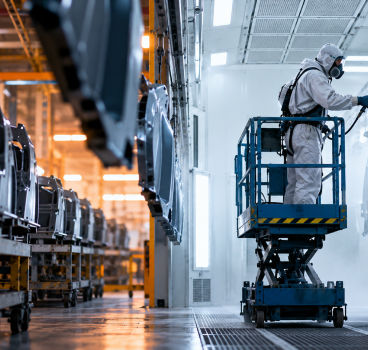
Why Paint Booth Efficiency Has Become a Manufacturing Bottleneck in 2026
Your production line always seems to run smoothly until painted parts start piling up at the booth. While you've optimized fabrication and assembly, outdated access equipment and rising quality...
Read more5 Construction Project Management Myths That Cost Crews Productive Time
Construction project management myths are pervasive, and the real cost is lost crew hours, not just lost money. Watch out for common misconceptions that can undermine your workforce's productivity...
Read more

The Robotics as a Service Revolution Is Reshaping Warehouse Infrastructure Requirements
Warehouse operators now rent automation equipment instead of purchasing it outright. These robotics as a service models provide access to advanced machines without major capital investments. As...
Read more