
The Mortar Behind the Magic of Football’s Greatest Stages
At CPI, we have a proud history of supplying our high-quality mortar for buildings varying in stature and purpose. And as sports fans across the globe eagerly await the start of the tournament, we are pleased to say that our project portfolio includes high-profile UK football stadia and associated infrastructure, writes Stuart Russell, Head of Commercial at CPI Euromix.
Football grounds matter. They are places of worship for millions of followers of the national game. In such places dreams are made, friendships are built, and families gather to enjoy a shared passion that is often handed down through the generations.
Football stadia are not just bedecked in the colours of the occupant team; they are enveloped in history. The mere glimpse of a ground’s entrance or an iconic stand can be enough to stir memories of glories past – and moments not-so salubrious - in hardened fans.
Foundational passion
At many larger stadia, the bond between supporters and their team is literally etched into the foundations. In a dedicated area of the ground, fans can buy a brick and have it display their name or that of a loved one, as part of a commemorative wall portraying the particulars of hundreds, and sometimes, thousands of like-minded souls who want their commitment to their beloved club to be known for as long as time and the structure’s wellbeing allows.
Football stadia in the higher echelons of the English game have undergone a huge transformation in the past couple of decades. No longer the crumbling concrete edifices of yore, England is now home to some of the best-equipped and most attractive grounds in Europe and the world; grounds that offer unprecedented safety and an unforgettable matchday experience for home fans and visiting supporters alike.
Supporting structural evolution
It's therefore gratifying that CPI should have played a part in the structural revolution of a number of top-tier English football grounds. At Anfield, home of six-time Champions League winners Liverpool, our natural and coloured mortars were respectively used for the blockwork and external work of the club’s new main stand. With circa 8,500 seats, the facility is one of the largest all-seater single stands in Europe, increasing Anfield’s capacity to 54,000.
Our natural-coloured mortar was also selected for the building of Arsenal’s Emirates Stadium. Opened in 2006, the 60,000 north London venue replaced the club’s former home, Highbury, less than a mile away. It means on matchdays, fans can take a short walk through time to arrive at their current abode.
Another Premier League stadium to benefit from our pioneering products was Stamford Bridge, the west London home of Chelsea FC. We supplied brickwork contractor, Irvine-Whitlock, with silos of dry-mixed mortar for a redevelopment that included Chelsa Village, the stadium’s commercial element comprising a shop, bars, a music venue, a hotel and restaurant.
Football success is largely earned on the training ground. It is also where the football stars of tomorrow are born. For the building of Manchester City’s world-class training facility, CPI supplied natural and coloured mortar, as well as specialist white lime mortar. The state-of-the-art academy is not only a schooling ground for future City professionals; the venue’s community function supports the development of elite athletes and local students.
In Manchester’s ‘other half’, CPI provided the mortar for an upgrade to Manchester United’s ‘Carrington’ training ground. The £25m renovation introduced a new medical and sports science facility to the site where the likes of David Beckham and Gary Neville plied their trade during ‘the Reds’ last golden era of success.
Even non-football fans will – perhaps grudgingly – understand why the sport and its storied stadia mean so much to fans whose happy space for the next month or so will be in front of the TV being sure not to miss every last kick, save, tackle and dive of this year’s World Cup.
Let’s hope the beautiful game lives up to its reputation, and at least one of the two home nations taking part gives us a thrill along the way. If not, then let us take comfort in the fact that even if football doesn’t come home (again), the UK will still be home to some of the world’s best stadia, which lest we forget, contain some world-class mortar.
Additional Blogs
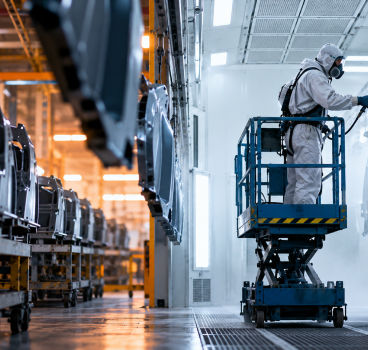
Why Paint Booth Efficiency Has Become a Manufacturing Bottleneck in 2026
Your production line always seems to run smoothly until painted parts start piling up at the booth. While you've optimized fabrication and assembly, outdated access equipment and rising quality...
Read more5 Construction Project Management Myths That Cost Crews Productive Time
Construction project management myths are pervasive, and the real cost is lost crew hours, not just lost money. Watch out for common misconceptions that can undermine your workforce's productivity...
Read more

The Robotics as a Service Revolution Is Reshaping Warehouse Infrastructure Requirements
Warehouse operators now rent automation equipment instead of purchasing it outright. These robotics as a service models provide access to advanced machines without major capital investments. As...
Read more