
Saving lives and businesses since 1877
In February 1877, a fire broke out in a Massachusetts mill. It was, by most accounts, an unremarkable fire and the kind of incident that at any other time would have gutted a building, destroyed livelihoods, and perhaps cost lives. But on this occasion, something different happened. The fire at the American Linen Mill in Fall River was stopped in its tracks before it had the chance to become catastrophic. It was the world's first documented sprinkler save. Nearly 150 years later, we are still telling that story because the principle proved that day remains entirely unchanged, writes Tom Roche, secretary at the Business Sprinkler Alliance.
It would be easy to assume that automatic sprinklers are a modern invention, a product of recent building codes and advancing engineering. They are not. The Parmelee Automatic Sprinkler, manufactured by Frederick Grinnell, was already installed in that Fall River mill when the fire broke out. It had been developed from an earlier installation in a New Haven piano factory, where owner Henry Parmelee wanted practical protection for his property. The system was brilliantly uncomplicated: a brass body connected to water piping, with a metallic cap held in place by solder engineered to melt at a set temperature. Heat melted the solder. The cap released. Water followed. There are no wires and no sensors, only heat, physics, and water, working together automatically. It asks nothing of the people in the building, it simply works.
While sprinklers have been refined and improved over the decades using new materials and scientific design, being set off by heat remains the core principle of every sprinkler head installed today. For those of us who work in fire safety, there is something quietly remarkable about that. The fundamental design Parmelee and Grinnell developed has thrived and the evidence for why is overwhelming.
What the evidence tells us
Sprinklers are not a theoretical safeguard. UK Research has shown that sprinkler systems have an operational reliability of 94%, and when they do activate, they extinguish or contain the fire in 99% of cases across a wide range of building types.1 Those are not marketing figures, they are the product of real-world incident data which is repeated across many countries. Sprinklers remain the most effective active fire suppression measure we have, capable of controlling a fire in its earliest stages, limiting fire growth before structural compromise, and before the conditions that cost lives and destroy businesses.
Knowledge gap
Despite nearly 150 years of proof behind it, misconceptions persist. At the BSA, we see it regularly. Developers, consultants, financiers, and even some construction professionals still debate the merits of sprinkler installation without a clear understanding of how they actually work. The most common misunderstanding is that all sprinklers activate simultaneously. Sadly, as we often say, that is the stuff of movies. They are triggered thermally so only the sprinklers directly exposed to the fire's heat will activate. They do not respond to smoke. They will not trigger because someone has burned their toast. The response is targeted, proportionate, and automatic.
This is not a trivial misunderstanding. When decision-makers reach inaccurate conclusions about cost, disruption, or necessity, buildings go unprotected that should not be. The lessons of 1877 are being set aside, not out of malice, but out of a knowledge gap that our industry has a responsibility to close.
Sprinklers should be viewed as a long-term investment in safety, not merely a one-time expense, and certainly not dismissed without a genuine understanding of what they do.
An anniversary worth marking
At the Business Sprinkler Alliance, we believe this anniversary deserves more than a footnote. Nearly 150 years of evidence is not a coincidence, it is a consistent, repeatable demonstration that early intervention limits consequences. Sprinklers protect life and property. They work. They have worked for generations. Our task now is ensuring sprinklers are specified, installed, and championed where they are needed most.
Additional Blogs
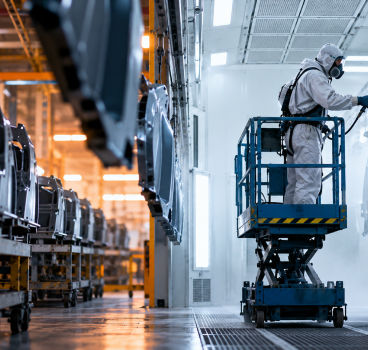
Why Paint Booth Efficiency Has Become a Manufacturing Bottleneck in 2026
Your production line always seems to run smoothly until painted parts start piling up at the booth. While you've optimized fabrication and assembly, outdated access equipment and rising quality...
Read more5 Construction Project Management Myths That Cost Crews Productive Time
Construction project management myths are pervasive, and the real cost is lost crew hours, not just lost money. Watch out for common misconceptions that can undermine your workforce's productivity...
Read more

The Robotics as a Service Revolution Is Reshaping Warehouse Infrastructure Requirements
Warehouse operators now rent automation equipment instead of purchasing it outright. These robotics as a service models provide access to advanced machines without major capital investments. As...
Read more