
One accident changed everything and now one Innovation Is changing bricklaying
New products, digital technologies and modern methods of construction continue to reshape how we design and build our buildings, but some of the most important innovations don't begin in a laboratory or a research facility - they begin on site, born out of experience, frustration and sometimes, tragedy. That is exactly the story behind The Brick Bud, writes John Ridgeway.
Created by Carl Harris, Managing Director of Harris Brick Safety Systems, The Brick Bud was not developed to create another construction product. It was developed because Carl experienced first-hand the devastating consequences of a wall collapse while working as a bricklayer. The accident left him with life-changing injuries, multiple operations and two years away from work, ultimately forcing him to rethink his entire career.
Rather than accepting that temporary wall collapses were simply "part of the job", Carl asked a different question - why are we still supporting unfinished masonry walls using methods that have changed so little in decades? Today, that question is beginning to change the way the industry thinks about temporary masonry support.
Innovation That Started with One Simple Idea
For generations, temporary brickwork has often been braced using timber. While familiar, these methods can prove unreliable when incomplete walls are exposed to high winds, resulting in wall collapses, costly rebuilds and, in the worst cases, serious injury. The Brick Bud was designed to remove that risk.
The adjustable support system transfers lateral loads safely into the ground, stabilising newly constructed walls until permanent stability is achieved. Lightweight, quick to assemble and designed to fit easily within site operations, it gives bricklayers and site managers confidence that the wall they leave at the end of the day will still be standing the following morning. But while improved safety was the original objective, the industry's response has shown that the benefits extend much further.
Safety Is Only Part of the Story
Every wall collapse has consequences. There are the obvious costs of replacing damaged brickwork, clearing debris and rebuilding the wall. Then there are programme delays, damaged materials, rising insurance premiums, temporary works redesigns and lost productivity across the project.
Carl estimates that if around 23% of walls experience some form of collapse, the direct cost of rebuilding masonry alone could exceed £122 million every year, before labour, waste disposal and associated delays are considered.
Then there is the environmental cost. Each wall that has to be rebuilt represents wasted bricks, additional cement, transport emissions and unnecessary embodied carbon. Harris Brick Safety Systems estimates that around 35 million bricks are wasted each year due to wall collapses, generating significant additional carbon emissions and undermining the industry's net zero ambitions.
At a time when construction is under increasing pressure to improve both safety and sustainability, preventing waste before it occurs makes commercial as well as environmental sense.
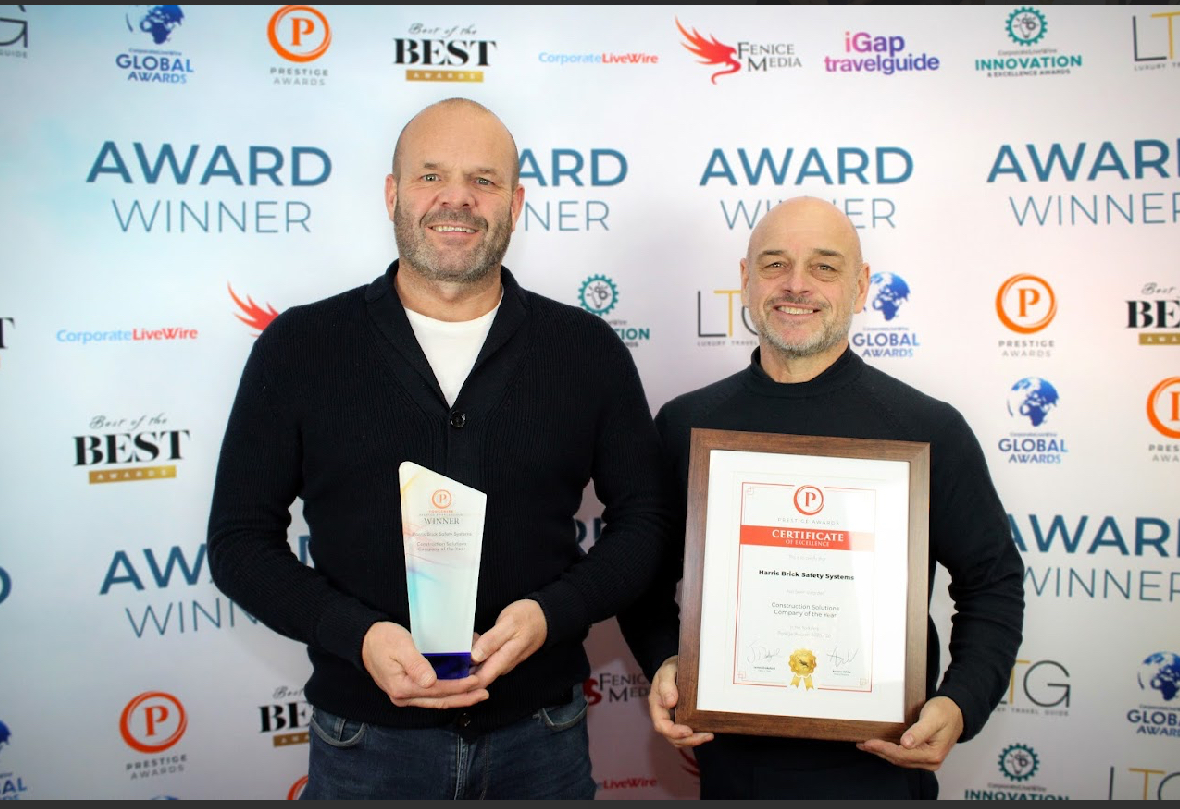
From Industry Scepticism to Industry Recognition
Like many innovations, The Brick Bud initially faced the challenge of changing established working practices, but today, that picture looks very different.
The system has now been adopted or trialled by leading housebuilders including Crest Nicholson, Lovell Homes and Bellway. According to Harris Brick Safety Systems, since Crest Nicholson benchmarked the system on site, it has not experienced a single wall collapse where The Brick Bud has been used. Lovell Homes has also reported positive results during its trials.
Momentum has continued to build throughout 2025. Among the company's recent achievements are:
- NBCA Gold Awards (2024) for Construction Champion and Innovation.
- NBCA Silver Award (2025) for Construction Champion.
- Stephenson Shield Award for Health, Safety and Innovation.
- North West Construction Health & Safety Group Innovation Award.
- Recognition through the Government-backed Net Zero Innovation Scheme.
- A Smart Grant supporting further research and development in collaboration with Leeds Beckett University.
- Support from Tees Valley Combined Authority through its STABLE programme.
- A successful presentation at Jewson's Dragons' Den, leading to collaboration on introducing The Brick Bud into its hire fleet.
- Growing international interest, including initial sales into Australia and discussions within the Irish infrastructure sector.
- And more recently, support from Farnham Homes.
The company has also been working with organisations including the NOCN Group and Our Future Education to support skills development, while more than 700 students have now received Brick Bud training nationally, helping embed safer temporary masonry practices into the next generation of construction professionals.
Winning Hearts Through Education
However, perhaps one of the most significant aspects of Harris Brick Safety Systems' journey has been its commitment to education. Rather than simply manufacturing a product, the business has invested heavily in training bricklayers, colleges, apprentices and site teams on the importance of temporary wall stability. That educational approach is becoming increasingly relevant.
Recent industry guidance, including publications highlighting the importance of temporary bracing under the Construction (Design and Management) Regulations, the Health and Safety at Work Act and BS 5975, continues to reinforce the importance of properly designed temporary works. This means that the conversation is gradually moving away from asking "How have we always done it?" towards asking "Is there a safer way?"
Building Partnerships Across the Industry
The Brick Bud's success has also been driven by collaboration. Housebuilders, merchants, universities, educators, local authorities and industry bodies have all played a role in helping develop, test and validate the system and that collaboration continues to grow.
Discussions with major contractors, support from organisations such as Tilbury Douglas, recognition from the NHBC Foundation and engagement with policymakers demonstrate that temporary wall safety is increasingly being viewed as an industry-wide issue rather than simply an individual site responsibility.
Changing an Industry
The construction industry often talks about innovation in terms of digital twins, artificial intelligence and robotics. Those technologies undoubtedly have their place. Sometimes, however, the most important innovation is the one that prevents someone else from experiencing the accident you once suffered yourself.
This is why the Brick Bud represents far more than a temporary wall support system. It demonstrates what can happen when lived experience, determination and engineering come together to solve a genuine industry problem.
Every safer site, every wall that remains standing after high winds and every apprentice trained to think differently represents another step towards changing construction for the better.
If the industry's ambition is to build safer, reduce waste, lower carbon and improve productivity, perhaps the biggest lesson from Harris Brick Safety Systems is that meaningful innovation doesn't always come from the largest companies. Sometimes it comes from one bricklayer who refused to accept that "it's always been done that way."
Additional Blogs

How to Take Your Team from Reactive Problem-Solving to Proactive Planning
Many jobsites rely on reacting to issues as they appear, leading to costly fixes and avoidable delays. Shifting to a forward-planned environment, where all trades work from a shared plan, helps teams...
Read moreDesigning with large trees and how architects can create immediate impact
Architecture is often judged by the relationship between buildings and their surroundings, but even an exceptional building can feel unfinished when it sits within a landscape of young trees, exposed...
Read more
The numbers don’t lie: why industrial fire statistics demand a response
Every year the government publishes its fire statistics, and every year those of us in the fire safety sector read them with a mixture of curiosity and concern. Curiosity, because they represent an...
Read more