
Moving beyond traditional telematics with safety-first connected fleet platforms
For many years, traditional telematics delivered a wealth of operational insight, from vehicle tracking to driver behaviour monitoring. But as construction programmes grow more complex, urban sites become busier and compliance demands intensify, it is increasingly clear that the technology’s value cannot be judged by the data it accumulates, writes Mervyn O’Callaghan, CameraMatics Founder and CEO.
Managing tippers, mixers, plant transporters and specialist vehicles in that environment requires a different way of thinking about information. Rather than asking, “What can we measure?”, the question ought to be: “What helps us make better decisions?” That shift marks the evolution from traditional telematics to connected fleet intelligence, and from safety as a cost of doing business to safety as the operating system of the construction fleet.
The next generation of technology is not defined by more sensors or more dashboards. It is designed around actionable intelligence: information that prevents incidents, improves operational performance and supports better-informed decisions at every stage of a project.
From monitoring drivers to backing them
Traditional telematics reduced performance to a simplistic view of harsh braking and acceleration events. Yet construction drivers work in some of the most demanding environments on the road, where context is everything. A sudden stop to avoid a cyclist at a site entrance is not poor driving; it is exactly the judgement we employ professionals to exercise.
Connected platforms recognise that distinction. Ours combines AI video intelligence, intelligent driver aids and real-time operational analytics in a single ecosystem, designed to serve the professional behind the wheel as much as the manager behind the dashboard. A context-aware driver score can rise, rather than fall, after an emergency manoeuvre that prevents a collision, while automated coaching gives drivers ownership of their own improvement without creating a culture of blame.
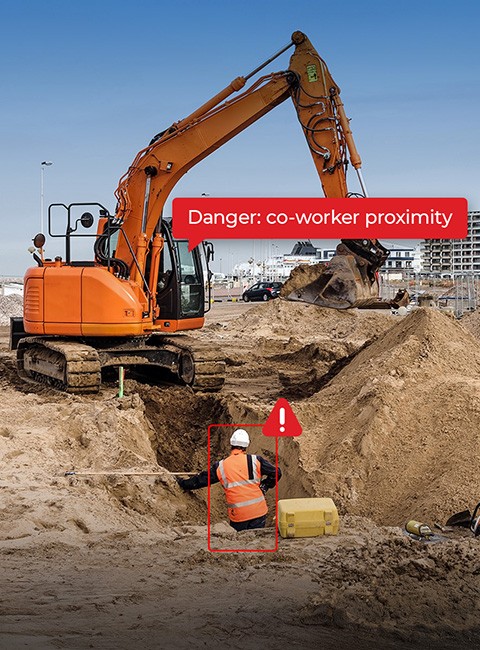
To avoid distraction while driving or operating machinery Information is integrated into existing vehicle displays instead of adding another beeping screen to the cab. Technology should stand beside the driver, not over them, and that is what builds trust, engagement and a genuine safety culture.
Safety as an operating system, not a bolt-on
The same disciplines that make driving safer improve the entire operation:
- Predictive maintenance: flags a developing fault weeks before a warning light appears, so a mixer never loses a full load on the hard shoulder. Across our customer base we see a 70% reduction in unexpected breakdowns and a 32% fall in maintenance costs.
- Intelligent utilisation data: a lorry-mounted crane may be on site for five hours and lifting for only one, a hidden cost invisible to a job sheet, and a route to fleet reductions of up to 5%.
- Integrated digital workflows: inspections, safety checks and job sign-offs completed consistently, site by site.
Safety technology did not set out to find that money. It found it because visibility, once established, illuminates everything.
This matters commercially. Clients increasingly expect contractors to evidence robust safety cultures, measurable ESG performance and operational transparency. Connected fleet platforms provide the proof businesses need to satisfy compliance requirements, strengthen tender submissions and differentiate themselves in a competitive marketplace.
Ultimately, construction operators face a strategic choice, and it is not really about hardware. It is about whether technology exists to catch people out or to help them succeed. The businesses choosing the latter are discovering that safer operations are simply better-run ones, where safety, operational performance and commercial success are no longer separate objectives, but outcomes driven by the same connected intelligence.
Additional Blogs
Why Paint Booth Efficiency Has Become a Manufacturing Bottleneck in 2026
Your production line always seems to run smoothly until painted parts start piling up at the booth. While you've optimized fabrication and assembly, outdated access equipment and rising quality...
Read more5 Construction Project Management Myths That Cost Crews Productive Time
Construction project management myths are pervasive, and the real cost is lost crew hours, not just lost money. Watch out for common misconceptions that can undermine your workforce's productivity...
Read more
The Robotics as a Service Revolution Is Reshaping Warehouse Infrastructure Requirements
Warehouse operators now rent automation equipment instead of purchasing it outright. These robotics as a service models provide access to advanced machines without major capital investments. As...
Read more