
How risk Is routinely pushed down the supply chain
Risk is an unavoidable part of construction. Every project involves uncertainty around ground conditions, weather, design coordination, procurement, labour and programme. Yet while risk is inherent, the way it is distributed across the industry is neither neutral nor accidental. In modern construction, risk is routinely pushed down the supply chain, away from those with the greatest influence over decisions and often onto those with the least ability to absorb it, writes John Ridgeway.
This practice has become normalised to the point that it is rarely questioned. Contracts, procurement routes and commercial behaviours all reinforce the same pattern. Risk is transferred, not managed and the consequences ripple through project delivery, quality, safety and long-term value.
At the heart of this issue lies a misconception. Risk cannot be eliminated simply by assigning it to someone else. It can only be understood, mitigated or absorbed. However, many construction contracts are drafted as if risk were a commodity that can be passed down the chain and disappear from view.
Main contractors often accept broad obligations under pressure of competition, programme and margin. To protect themselves, they mirror those obligations in subcontracts, frequently with tighter terms, less time and reduced scope for negotiation. By the time risk reaches specialist subcontractors and suppliers, it has often been magnified rather than clarified.
This creates an illusion of control at the top of the chain. On paper, the risk has been transferred. In reality, it still exists, now carried by organisations less equipped to manage it.
Procurement drives the behaviour
Procurement models play a central role in shaping how risk is allocated. Competitive tendering, particularly where price is the dominant factor, encourages the aggressive transfer of risk. Contractors know that taking on additional liability reduces their attractiveness, so they push it downward to protect commercial viability.
Subcontractors, often operating on thin margins, face a stark choice. Accept unfavourable terms or walk away from work. In a crowded market, walking away is rarely a realistic option. Risk is therefore accepted not because it is manageable, but because it is unavoidable.
This dynamic is especially pronounced in specialist trades. Waterproofing, cladding, M&E and groundworks contractors are frequently expected to warrant aspects of design, performance and coordination over which they have limited control. The imbalance between responsibility and authority becomes structural rather than incidental.
One of the most persistent examples of misplaced risk is the transfer of design responsibility without genuine design control. Contractors and subcontractors are often required to “take responsibility” for design elements that are already constrained by planning, performance specifications or architectural intent.
In theory, this aligns responsibility with delivery. In practice, it frequently results in contractors inheriting risk associated with decisions made earlier in the project lifecycle. Value engineering exercises, late design changes and incomplete information further compound the issue. When problems emerge, the contractual position may be clear, but the root cause is not. Risk has been transferred, but not resolved.
As a result, pushing risk down the supply chain has a direct impact on quality. When contractors are exposed to disproportionate liability, they respond defensively. This often manifests as conservative design choices, minimal compliance rather than best practice and resistance to alternative approaches.
Innovation suffers in this environment. New materials, systems or methods introduce uncertainty and uncertainty equates to risk. Where liability is high and margins are low, there is little appetite for experimentation. The industry continues to rely on familiar solutions, even when better options exist.
Over time, this defensive posture becomes embedded. Risk transfer discourages the very behaviours that clients and policymakers say they want such as innovation, collaboration and continuous improvement.
Financial fragility in the supply chain
The cumulative effect of risk transfer is financial fragility. Smaller subcontractors and suppliers carry significant exposure relative to their balance sheets. A single dispute, delay or defect can threaten viability.
This fragility is not theoretical. The industry has seen repeated cycles of insolvency, often triggered by withheld payments, disputed variations or claims linked to transferred risk. Each failure sends shockwaves through projects, causing delays, cost overruns and loss of expertise. Ironically, the parties pushing risk down the chain are often the ones most affected when that chain breaks. Projects do not fail in isolation. They fail because systems are weakened.
Perhaps the most problematic aspect of this practice is that risk is rarely accompanied by appropriate reward. Subcontractors may carry liability for programme, performance or coordination, but without the commercial upside that would justify that exposure.
This imbalance undermines trust. When risk is perceived as unfairly allocated, relationships become transactional and adversarial. Collaboration gives way to contractual positioning. Issues are managed through claims rather than dialogue. The industry then expends time and resources managing conflict rather than delivering value.
Insurance is often cited as a safety net, but it does not solve the underlying issue. As risk is pushed down the supply chain, insurance premiums rise, exclusions increase and cover becomes harder to obtain. Some risks are simply uninsurable, leaving contractors exposed despite contractual obligations.
This creates a false sense of security. Contracts assume insurance will respond, but when claims arise, the reality is more complex. Disputes over coverage add another layer of cost and delay, further eroding project outcomes.

Compliance regimes can also exacerbate the problem. Where responsibility is fragmented, compliance becomes a box-ticking exercise rather than a coherent strategy. Risk is managed on paper rather than in practice.
Towards more balanced risk allocation
There are alternatives. Projects that perform well tend to approach risk as a shared challenge rather than a liability to be avoided. Early contractor involvement, transparent design development and realistic programmes all contribute to more balanced risk allocation.
When parties with decision-making power retain appropriate responsibility, risk is more likely to be managed proactively. This encourages better information flow, earlier problem-solving and a greater willingness to innovate. However, balanced risk does not mean equal risk. It means aligning risk with the ability to influence outcomes. This is a subtle but critical distinction.
It is tempting to frame risk transfer as a behavioural problem, but it is fundamentally structural. As long as procurement, contracts and commercial incentives reward the offloading of risk, the behaviour will persist.
Addressing this requires a shift in how success is measured. Projects should be evaluated not just on cost and programme, but on resilience, quality and long-term performance. This demands a more mature conversation about risk, one that recognises its inevitability and focuses on management rather than avoidance.
Ultimately, pushing risk down the supply chain undermines the very outcomes construction seeks to achieve. It weakens relationships, stifles innovation and increases the likelihood of failure.
A more sustainable industry requires trust, transparency and accountability aligned with influence. Until risk is treated as a shared reality rather than a contractual weapon, the supply chain will remain under strain. The question is not whether construction can afford to change this approach, but whether it can afford not to.
Additional Blogs
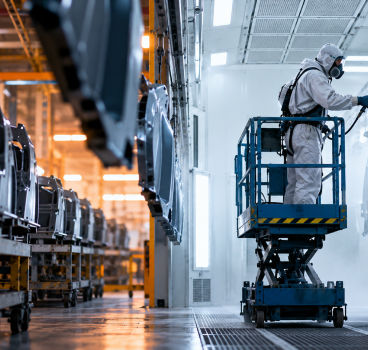
Why Paint Booth Efficiency Has Become a Manufacturing Bottleneck in 2026
Your production line always seems to run smoothly until painted parts start piling up at the booth. While you've optimized fabrication and assembly, outdated access equipment and rising quality...
Read more5 Construction Project Management Myths That Cost Crews Productive Time
Construction project management myths are pervasive, and the real cost is lost crew hours, not just lost money. Watch out for common misconceptions that can undermine your workforce's productivity...
Read more

The Robotics as a Service Revolution Is Reshaping Warehouse Infrastructure Requirements
Warehouse operators now rent automation equipment instead of purchasing it outright. These robotics as a service models provide access to advanced machines without major capital investments. As...
Read more