
Construction’s obsession with blame instead of learning
Construction is one of the most technically advanced industries in the built environment, yet culturally it often behaves like one of the least reflective. When things go wrong and they frequently do, the default response is not to ask why the system failed, but who can be held responsible. Blame moves quickly, learning rarely does, writes John Ridgeway.
This instinct is deeply ingrained. Contracts are structured around liability, programmes are protected through defensive reporting and project teams are assembled knowing they will disband before consequences fully emerge. In this environment, mistakes are treated as personal failures rather than predictable outcomes of complex systems. The result is an
The construction industry’s blame culture is not accidental. It is reinforced by the way risk is allocated contractually. From the earliest stages of procurement, roles are defined less by collaboration and more by where responsibility begins and ends. This encourages every party to protect their own position rather than improve the collective outcome.
When something fails, the first question is rarely “What conditions allowed this to happen?” It is “Who signed it off?” The fear of future claims shapes behaviour long before problems arise. Designers become cautious to the point of defensiveness. Contractors document relentlessly, not to improve quality, but to evidence compliance. Subcontractors learn quickly that transparency can be dangerous.
In such an environment, admitting uncertainty or highlighting emerging risks feels risky. It is safer to remain silent and rely on contractual protection than to expose potential flaws that might later be used as evidence.
Mistakes are treated as deviations
On most projects, issues are framed as exceptions. A defect is an isolated incident. A delay is caused by one trade. A coordination problem is attributed to an individual drawing or decision. Rarely are these events treated as signals of deeper systemic problems.
Yet construction is inherently complex. Multiple disciplines interact under time pressure, often with incomplete information and changing constraints. Mistakes are not anomalies; they are inevitable. Treating them as personal failures rather than system outputs prevents meaningful learning.
This is why post-project reviews so often disappoint. Lessons are recorded, circulated and promptly forgotten. They describe what went wrong, but not why it was allowed to happen repeatedly. Without confronting root causes, such as unrealistic programmes, fragmented responsibility, or poor information flow, the same issues resurface on the next project under a different name.
Blame does not just affect how problems are handled after they occur. It shapes behaviour long before that point. When people fear repercussions, they stop raising concerns early. Design risks remain unchallenged. Buildability issues are worked around quietly on site. Temporary fixes become permanent solutions because escalating them feels unsafe.
This silence is often misinterpreted as competence. The absence of reported issues is taken as evidence of control, when in reality it may indicate suppression. By the time problems surface, they are harder, more expensive, and more disruptive to resolve.
The industry frequently talks about the need for early engagement and collaboration, yet the underlying culture discourages the openness required for either to work effectively.
Industries that genuinely learn from failure, such as aviation or healthcare, understand that improvement depends on psychological safety. People must be able to report errors, near misses and uncertainties without fear of punishment. Construction rarely offers this environment.
Site teams often operate under intense pressure, balancing cost, time, safety and quality. Admitting a mistake in this context can feel like professional suicide. As a result, learning becomes superficial. Processes change on paper, but behaviour remains the same.
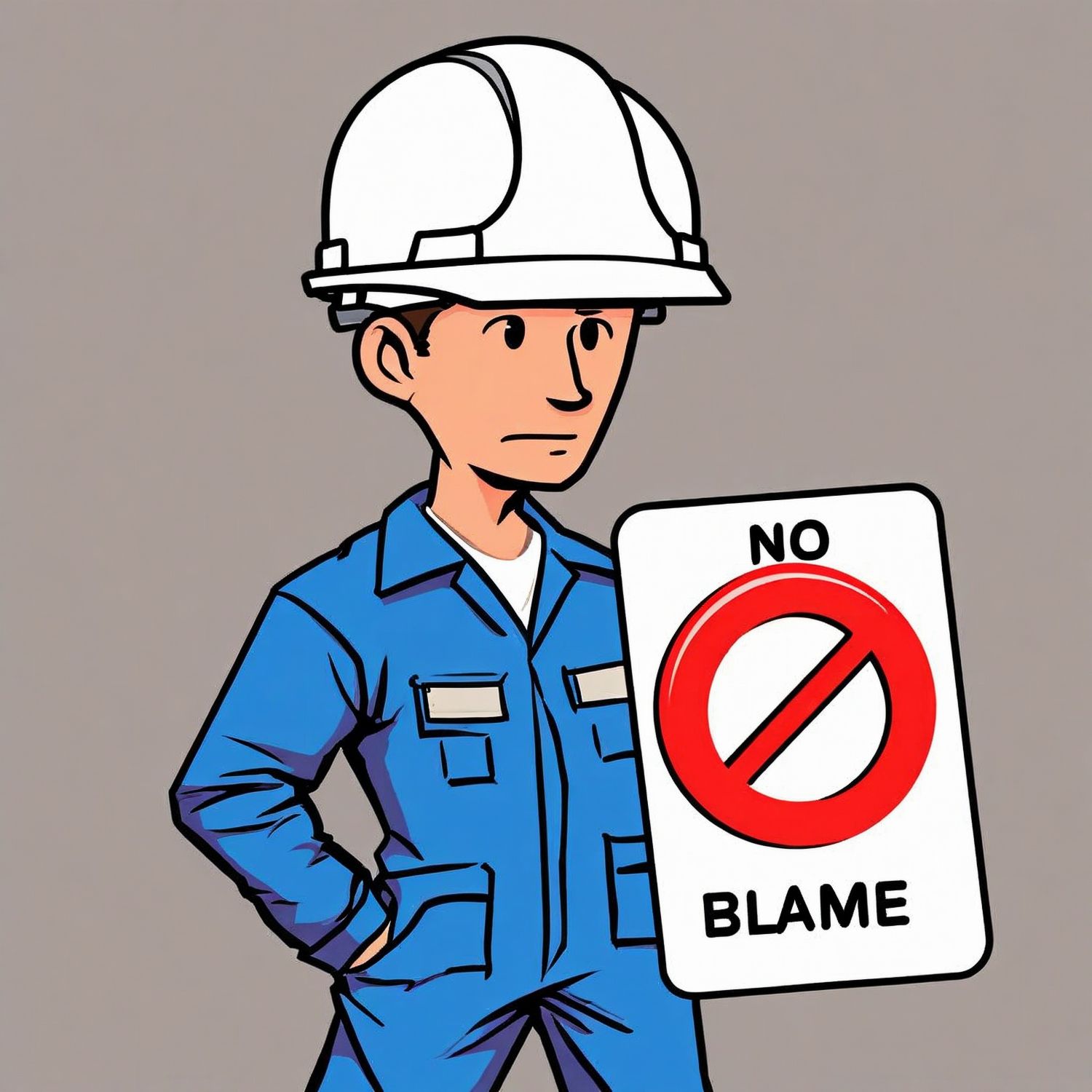
Without psychological safety, innovation also suffers. New approaches carry risk, and in a blame-driven culture, risk is avoided rather than managed. This helps explain why the industry struggles to move beyond incremental change despite constant calls for innovation.
Fragmentation encourages finger-pointing
Construction projects are temporary coalitions. Teams come together for a finite period, deliver a building, and then disperse. Accountability is fragmented across organisations with differing priorities, incentives and levels of influence.
When issues arise, this fragmentation makes it easy to externalise responsibility. Designers blame incomplete briefs. Contractors blame design information. Subcontractors blame sequencing. Clients blame everyone. Each explanation may contain some truth, but collectively they obscure the systemic nature of the problem. Because no single party owns the whole system, no one is incentivised to improve it. Learning requires continuity, but
The consequences of this culture are not abstract. They appear in repeated defects, escalating insurance costs, conservative design margins, adversarial relationships and declining trust across the supply chain. They also appear in burnout, as professionals carry the emotional weight of constant defensive working.
Time and money are spent resolving disputes rather than improving outcomes. The same coordination issues appear on projects year after year, despite better tools and more guidance. Knowledge is lost as experienced individuals leave the industry, frustrated by its inability to change.
Perhaps most damaging of all is the missed opportunity. Every project generates valuable insight about what works and what does not. When blame dominates, that insight is wasted.
However, changing this culture does not mean removing accountability. It means redefining it. Accountability should focus on improving systems, not punishing individuals for predictable outcomes.
This requires leadership that values openness over certainty and curiosity over control. It requires procurement models that reward collaboration and transparency rather than defensive behaviour. It also requires acknowledging that complexity cannot be eliminated, only managed.
Some projects already demonstrate this change. Where teams invest in early coordination, encourage challenge and treat issues as shared problems, outcomes improve. These projects are not perfect, but they adapt. They learn in real time rather than retrospectively.
Construction often describes itself as risk-averse, but in reality it is learning-averse. It prefers familiar problems to unfamiliar conversations. Moving beyond blame requires the industry to become more comfortable with uncertainty and more honest about its own limitations.
Learning is not a process to be completed at project close. It is a continuous activity embedded in how decisions are made, how information flows and how people are treated when things go wrong.
Until the industry values learning as highly as it values liability management, it will continue to repeat the same mistakes, only with better documentation. The buildings may change, but the culture will not. And that, more than any technical limitation, is what holds construction back.
Additional Blogs
Why Paint Booth Efficiency Has Become a Manufacturing Bottleneck in 2026
Your production line always seems to run smoothly until painted parts start piling up at the booth. While you've optimized fabrication and assembly, outdated access equipment and rising quality...
Read more5 Construction Project Management Myths That Cost Crews Productive Time
Construction project management myths are pervasive, and the real cost is lost crew hours, not just lost money. Watch out for common misconceptions that can undermine your workforce's productivity...
Read more
The Robotics as a Service Revolution Is Reshaping Warehouse Infrastructure Requirements
Warehouse operators now rent automation equipment instead of purchasing it outright. These robotics as a service models provide access to advanced machines without major capital investments. As...
Read more