
Are we ignoring water as the biggest threat to buildings?
Ask most people in construction what keeps them awake at night and you’ll hear the same answers about fire risk, structural failure, programme schedules and rising costs. They are all valid and serious. but there’s another threat - quieter, less dramatic and far more persistent. It’s called water and this is the one that causes more damage to buildings than almost anything else, writes John Ridgeway.
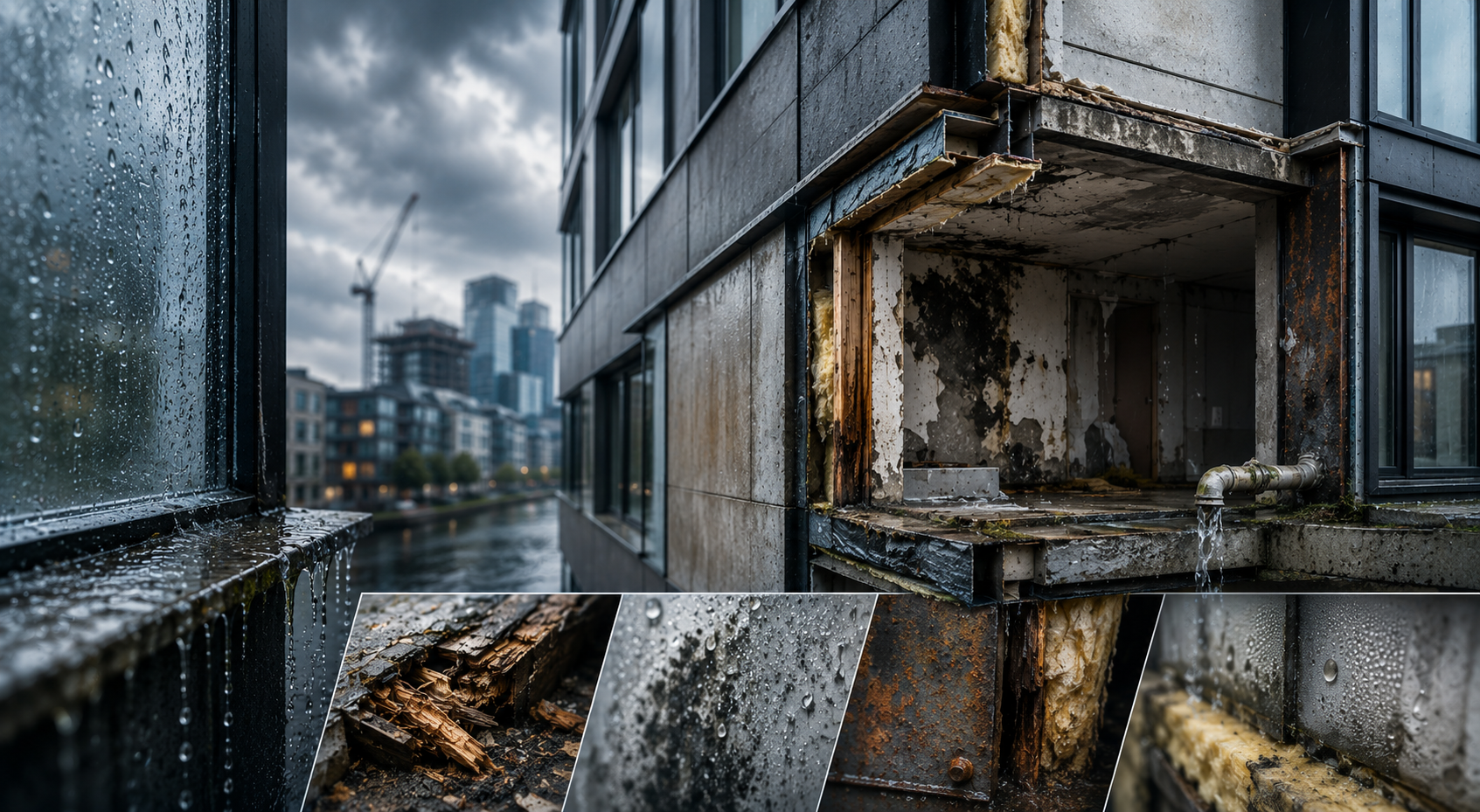
We are not talking about floods or storms. It is everyday water that causes the damage. Rain that finds its way in. Condensation that builds up unnoticed and leaks that go unresolved. It’s the kind of water damage that doesn’t make headlines, but quietly destroys buildings from the inside out.
The damage we don’t talk about
Water is responsible for a huge proportion of building failures. Insulation becomes saturated and loses performance. Timber elements begin to decay, steel corrodes and finishes fail. Mould then develops, bringing health risks and reputational damage and unlike fire or structural collapse, this doesn’t happen suddenly - it happens slowly, gradually and often invisibly. All this makes it far easier to ignore, until it becomes expensive to fix.
The Building Research Establishment has long identified moisture ingress as one of the most common causes of building defects in the UK. Insurance data tells a similar story, with escape-of-water claims consistently among the highest in both frequency and cost. This isn’t a niche issue, it’s systemic.
Why water is winning
So why are we still getting it wrong? Part of the problem is how we design. Modern buildings are more complex than ever. Multiple layers, interfaces, systems, are materials all needing to work together perfectly to keep water out and allow moisture to escape, but such complexity increases risk.
Every junction becomes a potential failure point. Every penetration is a weakness if not detailed correctly and every trade introduces another variable. Too often, these details are either poorly resolved at design stage, or compromised during construction.
Speed, cost and consequence
Then there’s the pressure to build quickly and cheaply. Tight programmes mean less time to get details right. Value engineering can strip out resilience, but substitution of materials introduces unknowns. Perhaps most critically, testing and verification often fall short.
This is because we assume systems will perform. We rely on drawings rather than reality and move on before performance is proven. Water doesn’t care about any of that., because It will always finds the weakness.
The buildings we can’t see
There’s also a deeper issue, when what happens after handover. Most water-related problems don’t appear during construction. They emerge later, when the building is in use.
Roof membranes degrade, sealants fail, drainage systems block and condensation builds within walls or roof voids. Facilities teams are left to manage issues that were often designed in from the start and because the damage is gradual, it’s rarely treated with urgency, until it escalates.
A blind spot in sustainability
Here’s where the conversation becomes even more uncomfortable. As the industry pushes towards sustainability, we’re focusing heavily on carbon, materials and energy performance.
They are all important, but what’s the environmental impact of a building that fails early due to water damage? If insulation becomes saturated, thermal performance drops.
If components decay, they need replacing. If systems fail prematurely, the whole-life carbon equation collapses. Durability is the real sustainability and water is one of the biggest threats to durability.
Mass timber and the warning signs
The debate around mass timber has brought this issue into sharper focus. Concerns about moisture ingress, whether from construction, occupancy or even fire suppression, highlight just how sensitive some modern materials are to water. But this isn’t a timber problem, it’s an industry problem.
If water can compromise performance to this extent, then we need to be far more honest about how we design, build and maintain buildings in a moisture-rich environment like the UK.
So what needs to change?
First, we need to stop treating water as a secondary risk. It should be central to design thinking andnot an afterthought.
That means:
- Better detailing at interfaces
- Greater emphasis on buildability
- More robust testing and verification
- Clear accountability for performance
It also means designing for maintenance. Buildings should be accessible, inspectable and repairable. Because water-related issues are not a question of if, but when.
We are not talking about floods or storms. It is everyday water that causes the damage. Rain that finds its way in. Condensation that builds up unnoticed and leaks that go unresolved. It’s the kind of water damage that doesn’t make headlines, but quietly destroys buildings from the inside out.
The damage we don’t talk about
Water is responsible for a huge proportion of building failures. Insulation becomes saturated and loses performance. Timber elements begin to decay, steel corrodes and finishes fail. Mould then develops, bringing health risks and reputational damage and unlike fire or structural collapse, this doesn’t happen suddenly - it happens slowly, gradually and often invisibly. All this makes it far easier to ignore, until it becomes expensive to fix.
The Building Research Establishment has long identified moisture ingress as one of the most common causes of building defects in the UK. Insurance data tells a similar story, with escape-of-water claims consistently among the highest in both frequency and cost. This isn’t a niche issue, it’s systemic.
Why water is winning
So why are we still getting it wrong? Part of the problem is how we design. Modern buildings are more complex than ever. Multiple layers, interfaces, systems, are materials all needing to work together perfectly to keep water out and allow moisture to escape, but such complexity increases risk.
Every junction becomes a potential failure point. Every penetration is a weakness if not detailed correctly and every trade introduces another variable. Too often, these details are either poorly resolved at design stage, or compromised during construction.
Speed, cost and consequence
Then there’s the pressure to build quickly and cheaply. Tight programmes mean less time to get details right. Value engineering can strip out resilience, but substitution of materials introduces unknowns. Perhaps most critically, testing and verification often fall short.
This is because we assume systems will perform. We rely on drawings rather than reality and move on before performance is proven. Water doesn’t care about any of that., because It will always finds the weakness.
The buildings we can’t see
There’s also a deeper issue, when what happens after handover. Most water-related problems don’t appear during construction. They emerge later, when the building is in use.
Roof membranes degrade, sealants fail, drainage systems block and condensation builds within walls or roof voids. Facilities teams are left to manage issues that were often designed in from the start and because the damage is gradual, it’s rarely treated with urgency, until it escalates.
A blind spot in sustainability
Here’s where the conversation becomes even more uncomfortable. As the industry pushes towards sustainability, we’re focusing heavily on carbon, materials and energy performance.
They are all important, but what’s the environmental impact of a building that fails early due to water damage? If insulation becomes saturated, thermal performance drops.
If components decay, they need replacing. If systems fail prematurely, the whole-life carbon equation collapses. Durability is the real sustainability and water is one of the biggest threats to durability.
Mass timber and the warning signs
The debate around mass timber has brought this issue into sharper focus. Concerns about moisture ingress, whether from construction, occupancy or even fire suppression, highlight just how sensitive some modern materials are to water. But this isn’t a timber problem, it’s an industry problem.
If water can compromise performance to this extent, then we need to be far more honest about how we design, build and maintain buildings in a moisture-rich environment like the UK.
So what needs to change?
First, we need to stop treating water as a secondary risk. It should be central to design thinking andnot an afterthought.
That means:
- Better detailing at interfaces
- Greater emphasis on buildability
- More robust testing and verification
- Clear accountability for performance
It also means designing for maintenance. Buildings should be accessible, inspectable and repairable. Because water-related issues are not a question of if, but when.
The uncomfortable truth
Fire is catastrophic, but rare. Water is constant. It doesn’t destroy buildings overnight.
It degrades them over time and that makes it far more dangerous, because it’s easier to ignore.
The question we should be asking
If we’re serious about building performance, durability and sustainability, we need to rethink our priorities. Not just how we design buildings to stand up, but how we design them to stay intact.
Because until we take water seriously, we’re not building resilience, we’re building risk.
The uncomfortable truth
Fire is catastrophic, but rare. Water is constant. It doesn’t destroy buildings overnight.
It degrades them over time and that makes it far more dangerous, because it’s easier to ignore.
The question we should be asking
If we’re serious about building performance, durability and sustainability, we need to rethink our priorities. Not just how we design buildings to stand up, but how we design them to stay intact.
Because until we take water seriously, we’re not building resilience, we’re building risk.
Frequently Asked Questions
1. Why is water one of the biggest causes of building failure?
Water can penetrate buildings through roofs, walls, joints, windows, service penetrations and drainage systems. Once inside, it can damage insulation, corrode steel, rot timber, encourage mould growth and reduce the lifespan of building components, making moisture one of the most common causes of building defects.
2. What is moisture ingress in buildings?
Moisture ingress is the unwanted movement of water into a building through defects in the building envelope, failed waterproofing, damaged roofs, poor detailing or construction errors. If left untreated, it can lead to structural damage, mould growth and expensive repairs.
3. What is the difference between water ingress and condensation?
Water ingress occurs when external water enters a building through leaks or defects, while condensation forms when warm, moisture-laden air comes into contact with colder surfaces. Both can cause significant damage if they are not properly managed.
4. How can architects reduce the risk of water damage?
Architects can reduce water-related risks by designing robust waterproofing details, simplifying complex interfaces, specifying proven systems, ensuring adequate drainage, considering buildability and designing buildings that can be easily inspected and maintained throughout their life.
5. Why is waterproofing so important in construction?
Effective waterproofing protects the building structure from moisture damage, improves durability, preserves thermal performance, reduces maintenance costs and extends the service life of the building. Poor waterproofing can lead to expensive remedial work and premature building failure.
6. What are the most common causes of water damage in buildings?
Common causes include failed roof membranes, poorly detailed junctions, blocked drainage systems, defective sealants, damaged waterproofing, leaking pipework, condensation, inadequate ventilation and poor workmanship during construction.
7. How does water affect a building's sustainability?
Water damage can significantly reduce a building's sustainability by shortening its lifespan, damaging insulation, increasing energy consumption and requiring materials to be repaired or replaced. Durable, dry buildings generally have a lower whole-life carbon footprint than buildings that require repeated remedial work.
8. Why is moisture management important for mass timber buildings?
Mass timber performs exceptionally well when properly designed and protected. However, prolonged exposure to moisture during construction or occupation can affect durability and performance. Effective moisture management is therefore critical for all timber construction projects.
9. What role does testing play in preventing water ingress?
Testing and verification help confirm that waterproofing systems, roofs, façades and building envelopes perform as intended before handover. Identifying defects during construction is significantly less expensive than repairing water damage after occupation.
10. Why do many water-related building problems appear after handover?
Many moisture-related defects develop gradually over time. Sealants age, membranes deteriorate, drainage systems become blocked and small leaks worsen. Because these issues often develop slowly, they may not become visible until months or years after completion.
11. What is whole-life building performance?
Whole-life building performance considers how a building performs throughout its entire lifespan, including durability, maintenance, repair requirements, operational efficiency and environmental impact. Preventing water damage is essential to achieving good long-term building performance.
12. How can the construction industry reduce water-related building defects?
Reducing water damage requires better design detailing, higher installation standards, improved waterproofing systems, thorough testing, effective quality assurance, planned maintenance and greater collaboration between designers, contractors and manufacturers throughout the project lifecycle.
Additional Blogs
Why Paint Booth Efficiency Has Become a Manufacturing Bottleneck in 2026
Your production line always seems to run smoothly until painted parts start piling up at the booth. While you've optimized fabrication and assembly, outdated access equipment and rising quality...
Read more5 Construction Project Management Myths That Cost Crews Productive Time
Construction project management myths are pervasive, and the real cost is lost crew hours, not just lost money. Watch out for common misconceptions that can undermine your workforce's productivity...
Read more

The Robotics as a Service Revolution Is Reshaping Warehouse Infrastructure Requirements
Warehouse operators now rent automation equipment instead of purchasing it outright. These robotics as a service models provide access to advanced machines without major capital investments. As...
Read more