
The History of Britain’s Indoor Plumbing Revolution
Today, flushing a toilet is one of the most unremarkable actions in modern life. We turn a handle or press a button, the waste disappears and we get on with our day. For most people in Britain, indoor plumbing is not a luxury or a technological achievement. It is an expectation.
Yet this everyday convenience represents one of the most significant transformations in the history of the built environment. The modern bathroom is the product of centuries of experimentation, engineering, public health reform and investment in infrastructure. Its arrival changed how houses were designed, how towns developed and how society understood cleanliness, privacy and disease.
The story of indoor plumbing is not just about inventing a better toilet. It is about learning how to bring clean water into buildings, remove wastewater safely, manage human waste on an urban scale and create the infrastructure needed to make these systems work reliably.
For much of British history, sanitation was a practical problem managed close to home. The modern bathroom emerged when that problem became a collective responsibility.
For centuries, most British homes had no dedicated bathroom in the modern sense. Access to water depended on local circumstances, wealth and the availability of wells, springs, pumps and public water supplies. Washing might take place in a portable basin, a shared bathing facility or a tub brought into a room when required.
Human waste was dealt with through a mixture of privies, cesspits and other local arrangements. In towns, where buildings stood close together and populations grew, these methods could become unpleasant and dangerous. Waste might contaminate water sources, overflow into streets or remain close to living spaces.
Wealthier households could afford greater privacy and more elaborate facilities, but even a well-appointed home was not necessarily connected to a reliable water supply or a sewer network. A toilet inside a building was only one part of the problem. Without dependable water and a safe way to remove waste, it could create new difficulties rather than solve existing ones.
There were earlier precedents for sophisticated sanitation. Roman Britain had aqueducts, drains and communal bathing facilities in some settlements, demonstrating that organised water management was possible on a substantial scale. However, these systems did not survive as a continuous, nationwide infrastructure. After Roman rule ended, sanitation developed unevenly, shaped by local needs, resources and settlement patterns. The challenge facing later generations was not to rediscover a single forgotten invention. It was to make effective sanitation practical for entire communities.
An Invention Looking for Infrastructure
The idea of flushing waste away is older than many people realise. Sir John Harington, a courtier during the reign of Elizabeth I, described a water closet in the late sixteenth century. His design demonstrated the principle, but it did not lead to widespread adoption.
Later inventors refined flushing mechanisms, traps and water closets. In the eighteenth and nineteenth centuries, improvements in plumbing helped make indoor toilets increasingly feasible, particularly in wealthier homes and public buildings.
But invention alone could not deliver a sanitation revolution. A flushing toilet requires a reliable water supply, pipes that can carry waste away, drainage that works by gravity or other means, and somewhere suitable for the wastewater to go. A toilet connected to an inadequate drain could transfer a local problem into a wider public health crisis. This distinction is central to the history of plumbing. The successful bathroom was never just a product. It was a system.
As manufacturing developed, plumbing components became more practical to produce, install and maintain. Improved pipework, valves, traps and sanitary fittings helped bring greater reliability to indoor systems. Bathrooms could increasingly be designed as permanent parts of buildings rather than temporary arrangements assembled around a washbasin and a tub. However, adoption remained uneven. Cost, building layout, water availability and the absence of public infrastructure continued to determine who could benefit.
The nineteenth century brought unprecedented urban growth. Industrialisation drew people into towns and cities, while housing and infrastructure frequently struggled to keep pace. Overcrowding, inadequate drainage and contaminated water contributed to serious public health problems.
Cholera outbreaks were particularly influential in changing attitudes towards sanitation. During the nineteenth century, investigators and reformers increasingly challenged the idea that foul smells were the principal explanation for disease. Evidence connecting contaminated water with cholera helped strengthen the case for safer water supplies and more effective waste management.
The work of physician John Snow during the 1854 Soho cholera outbreak became a landmark in the development of public health. His investigation helped demonstrate the importance of contaminated water, although understanding and acceptance of the mechanisms of disease developed over time.
The Great Stink of London in the summer of 1858 brought the capital's sewage problem into sharp political focus. The smell from the polluted River Thames became so intolerable that it helped force action on London's sanitation infrastructure.
Engineer Joseph Bazalgette became central to the resulting transformation. His system of major intercepting sewers helped divert sewage away from the most densely populated parts of London and supported the development of a more comprehensive approach to urban drainage.
Bazalgette's work was not the sole cause of improvements in public health, and sanitation reform continued over many decades. Nevertheless, it demonstrated the scale of engineering required to make a modern city function. Individual buildings could not solve a problem generated by an entire urban population. The modern bathroom depended on public infrastructure just as much as it depended on plumbing inside the home.
From Private Luxury to Everyday Expectation
During the late nineteenth and early twentieth centuries, indoor plumbing became more achievable for growing numbers of households. Expanding water networks, improved sanitary products, building regulations and rising expectations of domestic comfort all played a part.
The process was gradual rather than uniform. Wealthier homes often adopted bathrooms earlier, while many working-class households continued to rely on shared facilities or external toilets. In some British housing, outdoor sanitation remained common well into the twentieth century.
Public health reform changed the terms of the debate. Clean water and effective waste removal increasingly came to be seen as essential elements of a healthy community rather than optional conveniences for those who could afford them.
Housing design changed accordingly. Bathrooms required space, water connections, drainage routes and suitable ventilation. Developers and architects had to consider how these services would fit into the building, while plumbers and other trades became essential to delivering functioning homes.
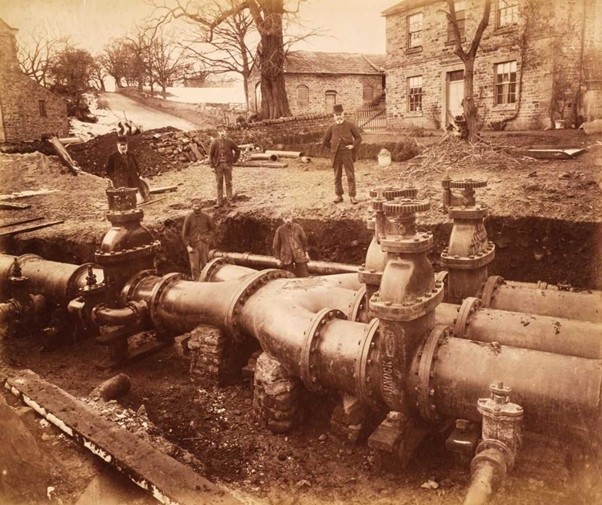
The bathroom also transformed domestic privacy. Washing and toileting could take place within the home, without the same dependence on shared or outdoor facilities. For households, this was a practical improvement; for building designers, it introduced a permanent set of technical requirements.
Mass housing, suburban development and the expansion of public services helped make indoor plumbing increasingly normal. Over time, a feature once associated with privilege became a baseline expectation of decent housing.
Modern plumbing is easy to overlook because its success depends on remaining largely invisible. Behind the bathroom walls and beneath the floor are carefully coordinated systems for supplying water, controlling pressure, carrying away wastewater and preventing foul air from entering occupied spaces.
Drainage needs appropriate gradients and pipe sizes. Traps help prevent sewer gases from entering rooms, while ventilation allows drainage systems to operate properly. Water supply systems must deliver sufficient flow and pressure and installations must be designed to reduce risks such as leakage and contamination.
These systems also have to work alongside the structure of the building. Pipework passes through floors, walls and service zones. Access is needed for maintenance, and poorly planned installations can create costly problems long after construction has finished.
The bathroom therefore offers a useful lesson in building design: some of the most important elements of a building are the ones people rarely see. A beautifully finished room is of little value if its drainage fails, its pipework leaks or its water supply is unreliable.
Modern plumbing is the result of engineering disciplines working together, from product design and materials science to civil engineering, building services and public infrastructure.
Sanitation Is Still an Engineering Challenge
The arrival of the modern bathroom did not bring the story of sanitation to an end. Water efficiency, ageing pipes, wastewater treatment, pollution and the resilience of drainage networks remain important challenges.
Climate change is adding pressure through heavier rainfall and greater risks of surface-water flooding in some locations. Drainage systems must cope with the demands of existing buildings and growing urban areas, while developers and infrastructure providers need to consider capacity, maintenance and long-term performance.
Water conservation is also becoming increasingly important. Toilets, showers, taps and other fittings can influence how much water a household consumes. Product design and building standards continue to evolve as the industry looks for ways to reduce waste without compromising hygiene or performance.
At the same time, not every building has the same needs. Hospitals, schools, care homes, commercial premises and homes each present different requirements for hygiene, accessibility, durability and maintenance. The principles developed through the history of sanitation remain relevant, even as the technologies change.
Britain's indoor plumbing revolution was not delivered by one inventor, one material or one engineering project. It emerged from the combination of practical inventions, scientific understanding, public health reform, changing social expectations and infrastructure built on a vast scale.
The flushing toilet became a normal part of everyday life because society learned to connect individual buildings to systems that could support entire communities. Engineers developed the networks, manufacturers improved the components, public authorities invested in sanitation and building professionals incorporated plumbing into the design of modern homes.
That achievement is easy to underestimate precisely because it works so well. We judge the bathroom by its appearance, convenience and comfort, but its real success depends on the network of engineering and public services operating behind the scenes.
The next time a toilet flushes, it is worth remembering that the sound marks the end of a process that begins far beyond the bathroom door. It is a small daily reminder of a much larger transformation - the point at which sanitation stopped being an individual household problem and became an essential part of how Britain builds, lives and maintains its towns and cities.
Frequently Asked Questions About the History of Indoor Plumbing
1. When did indoor plumbing become common in British homes?
Indoor plumbing became increasingly common during the late nineteenth and twentieth centuries, as water supplies, sewer networks and sanitary fittings improved. Adoption varied considerably according to household income, location and housing type, with outdoor toilets remaining in use in some British homes well into the twentieth century.
2. Who invented the flushing toilet?
There was no single inventor of the modern flushing toilet. Sir John Harington described an early water closet in the late sixteenth century, while later inventors improved flushing mechanisms, valves and sanitary designs. Widespread adoption depended on reliable water supplies and effective drainage infrastructure.
3. What was the Great Stink of London in 1858?
The Great Stink occurred during the hot summer of 1858, when the smell of sewage polluting the River Thames became intolerable. The crisis helped persuade Parliament to support major improvements to London's sewerage system, leading to one of the most significant civil engineering projects of the Victorian era.
4. How did Joseph Bazalgette transform Britain's sanitation systems?
Civil engineer Joseph Bazalgette designed a major network of intercepting sewers, pumping stations and associated infrastructure to carry sewage away from densely populated parts of London. His work helped establish a more effective approach to urban sanitation, and substantial sections of the Victorian sewer network remain in use today.
5. How did poor sanitation contribute to disease in Victorian Britain?
Inadequate waste disposal and contaminated water supplies contributed to the spread of waterborne diseases, including cholera. As investigators and public health reformers developed a better understanding of how contaminated water transmitted disease, pressure grew for cleaner water supplies, improved drainage and more effective sewage management.
6. What did people use before indoor toilets became widespread?
Many households relied on chamber pots, outdoor privies and cesspits. In some towns, waste was collected by workers for disposal or reuse, while overcrowding and poor drainage could leave human waste close to homes and water sources. Access to better facilities depended heavily on wealth and local infrastructure.
7. Why did the development of sewer systems matter as much as the invention of the toilet?
A flushing toilet only works effectively when waste can be carried away safely. Without suitable drains, sewers and a reliable water supply, flushing could transfer waste from individual homes into streets, rivers or already overloaded drainage systems. The sanitation revolution required coordinated investment in buildings and public infrastructure.
8. How did indoor plumbing change the design of British houses?
Bathrooms introduced new requirements for space, pipework, drainage, ventilation and access for maintenance. Architects, housebuilders and plumbers had to coordinate water and waste systems with the structure of the building. As indoor bathrooms became standard, they influenced floor plans, service layouts and expectations of domestic comfort.
9. When did having a bathroom become an expectation rather than a luxury?
The change took place gradually across the late nineteenth and twentieth centuries. Expanding public water and sewer networks, improvements in housing, more affordable sanitary fittings and rising public health expectations helped make indoor bathrooms increasingly normal. The pace of change differed between regions, communities and types of housing.
10. What challenges does modern plumbing still face?
Modern plumbing must address water conservation, ageing infrastructure, wastewater pollution, drainage capacity and the effects of heavier rainfall and flooding. Buildings also need systems that are accessible, reliable and straightforward to maintain. The history of sanitation demonstrates that good plumbing depends on more than individual products: it requires effective engineering, careful building design and investment in the infrastructure that connects communities.
Additional Articles

The 3,000-Year History of Scaffolding
The basic idea behind scaffolding is far older than steel, standardised fittings or modern health and safety. In fact, the first scaffolds were probably nothing more sophisticated than wooden poles...
Read moreThe Victorian ventilation revolution and what we forgot
Long before air conditioning, Victorian architects were designing buildings around a problem that has returned with a vengeance. How do you keep large, crowded buildings supplied with fresh air...
Read more
Why Georgian houses have surprisingly thin walls
Walk into a Georgian townhouse and the proportions can feel almost impossibly elegant. Tall windows, narrow façades and beautifully ordered brickwork give the impression of lightness. Yet behind that...
Read more