
The Buildings That Will Never Be Built
The construction industry has become increasingly good at measuring waste. We know how much material ends up in skips. We measure embodied carbon, track programme delays and analyse supply chain inefficiencies in extraordinary detail. Yet there is one form of waste that remains almost entirely invisible - the time, expertise and resources invested in projects that are never built, writes John Ridgeway.
Every year, thousands of planning applications are submitted across England. Government statistics show that around 261,700 planning decisions were granted during 2025, while 87% of all planning applications received approval. Those figures suggest that planning refusal, while frustrating for those affected, is not the biggest barrier to development. The greater challenge is what happens after planning.
Many schemes that receive permission never reach site. Rising construction costs, higher borrowing rates, changing market conditions, reduced investor confidence or shifts in client priorities can all render a viable project commercially impossible before the first foundation is excavated.
The Home Builders Federation recently highlighted the scale of the problem, reporting that planning permissions for new homes in England had fallen to 209,781 during the year to September 2025, the lowest annual figure for more than a decade and almost 40% below the 2022 peak. The organisation argues that viability, rather than the planning system alone, has become one of the greatest obstacles to delivering new development. That should concern everyone connected with construction because, by the time a project is abandoned, the investment has already been made.
Technical challenges solved
Long before contractors arrive on site, architects have developed concepts into detailed proposals. Structural and civil engineers have solved technical challenges. Ecologists have completed habitat surveys. Transport consultants have modelled junction capacities. Planning consultants have negotiated with local authorities. Legal teams have drafted agreements, while clients have commissioned feasibility studies, environmental assessments and public consultations.
Collectively, those activities represent thousands of hours of highly skilled professional work. They also represent millions of pounds of investment. Yet, unlike material waste, there is no national figure that tells us how much intellectual capital is lost every year because projects simply stop. Perhaps that is the industry's biggest blind spot.
Construction has embraced the concept of embodied carbon because it recognises that environmental impact begins long before a building is occupied. Shouldn't we apply similar thinking to the design process itself? Every cancelled development has already consumed energy through travel, digital modelling, surveys, meetings and countless hours of specialist consultancy. While these emissions are insignificant compared with constructing a major development, they are far from zero. Across hundreds or even thousands of abandoned schemes, the cumulative impact is likely to be considerable, yet it remains largely unmeasured.
The financial implications are equally significant. Design fees are not simply a cost to developers. They represent productive capacity across the entire construction supply chain. Every hour spent progressing a project that ultimately fails is an hour that could have been invested elsewhere. For architects, engineers and consultants, cancelled projects are an accepted commercial risk, but at an industry level they represent a substantial loss of knowledge, innovation and opportunity.
The uncomfortable question
This raises a more uncomfortable question. Are we measuring success in the wrong way? Planning permission is often viewed as the finish line for a development team, but in reality it is little more than a licence to begin the next phase. A project only creates social, economic and environmental value when it is delivered. Until then, it remains an aspiration rather than an asset.
Perhaps this is where the industry has the greatest opportunity to learn. Construction is exceptionally good at celebrating completed projects. We publish case studies, present awards and share lessons from successful delivery. By contrast, the projects that never reach site are quietly forgotten. Their drawings are archived, their digital models closed and their lessons rarely discussed.
Yet those unbuilt developments may hold some of the most valuable insights available to the industry. Why did viability collapse? What assumptions proved incorrect? Which risks could have been identified earlier? How might procurement, funding or planning strategies have been approached differently? Understanding why projects fail to progress could be every bit as valuable as understanding why others succeed.
The buildings that never get built may never shape our towns or cities, but they still shape our industry. They consume expertise, absorb investment, generate carbon and influence future decisions. The fact that we don't measure their true cost doesn't mean that cost doesn't exist. Perhaps it's time construction started paying as much attention to the projects that quietly disappear as it does to those that eventually transform the skyline.
Frequently Asked Questions
1. Why do construction projects get cancelled after planning permission has been granted?
Planning permission is only one step in the development process. Projects can still be cancelled due to rising construction costs, higher borrowing rates, changes in market demand, funding issues, supply chain challenges or revised client priorities. A scheme that was financially viable when designed may no longer be deliverable by the time construction is due to begin.
2. How many planning applications are approved in England?
According to UK Government statistics, around 87% of planning applications in England receive approval. This suggests that planning refusal is not the primary reason many developments fail to progress, with commercial viability often becoming the deciding factor.
3. Do all developments with planning permission get built?
No. Planning permission gives a developer the legal right to build but does not guarantee that construction will begin. Many approved schemes are delayed, redesigned or abandoned because economic conditions or project viability change before work starts.
4. What costs are incurred before construction begins?
Significant investment is made long before ground is broken. Developers typically commission architects, engineers, planning consultants, ecologists, transport specialists, surveyors and legal advisors. Site investigations, environmental assessments and public consultations also add to the overall cost of preparing a planning application.
5. Does cancelling a construction project create environmental waste?
Yes. Although no building materials may have been used, cancelled developments still consume resources through site visits, surveys, travel, digital modelling, meetings and professional consultancy. These activities all have an associated carbon footprint that is rarely measured.
6. Why is project viability becoming a bigger issue?
Higher interest rates, inflation, increased labour costs and rising material prices have significantly affected development economics. Many schemes that were commercially viable a few years ago no longer generate sufficient returns to justify construction.
7. What happens to the design work when a project is abandoned?
In many cases, the drawings, reports and digital models are archived and never used. While some design concepts may be adapted for future developments, much of the knowledge and innovation created during the design process is effectively lost.
8. How can developers reduce the risk of projects being abandoned?
Early feasibility studies, realistic cost planning, market analysis, stakeholder engagement and regular viability reviews can help identify potential risks before significant design costs are incurred. Maintaining flexibility throughout the design process also allows projects to adapt to changing market conditions.
9. Are planning delays always responsible for projects failing?
Not necessarily. While planning delays can increase costs and uncertainty, many developments fail because of changing financial conditions rather than planning decisions. Rising borrowing costs and declining market confidence have become major factors affecting project delivery.
10. What impact do cancelled developments have on the construction industry?
Abandoned projects affect the entire supply chain. Architects, engineers, consultants and contractors all invest time and expertise during the design phase. When projects are cancelled, that professional effort generates no completed asset, reducing productivity across the industry.
11. Should the construction industry measure the cost of unbuilt projects?
Many industry professionals believe it should. Measuring the financial, environmental and intellectual investment lost through cancelled developments could help improve decision-making, identify recurring risks and encourage more efficient project planning.
12. What lessons can the industry learn from projects that are never built?
Cancelled developments often reveal valuable insights into planning policy, procurement, financing, design strategy and commercial viability. Analysing why projects fail to progress can help developers, consultants and contractors reduce risk and improve the success of future schemes.
Additional Blogs

The Robotics as a Service Revolution Is Reshaping Warehouse Infrastructure Requirements
Warehouse operators now rent automation equipment instead of purchasing it outright. These robotics as a service models provide access to advanced machines without major capital investments. As...
Read moreIs construction becoming brilliant at measuring everything except common sense
Construction has never had access to more information. We can track the progress of a project almost in real time. We can monitor costs, labour, productivity, programme performance, carbon, waste,...
Read more
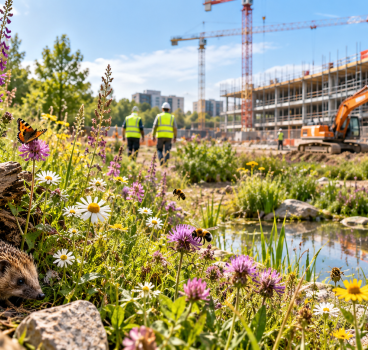
Rewilding construction sites to boost local biodiversity
At a time when the UK is facing a serious decline in wildlife, the construction industry has an opportunity to rethink its relationship with the natural environment. So let’s ask the question - could...
Read more