
The £10 Decision That Can Cost £10 Million
Construction projects are often judged by the big numbers. Multi-million-pound budgets, programme milestones, carbon targets and completion dates dominate project meetings. Yet some of the most expensive decisions made on any project are not measured in millions of pounds at all. They are measured in tens of pounds, writes John Ridgeway.
A seemingly insignificant specification choice, perhaps selecting a cheaper sealant, reducing the quality of a drainage component or changing the grade of a fixing to save a few pounds, can ultimately influence the performance of an entire building for decades. While each decision may appear commercially sensible in isolation, collectively they can create maintenance liabilities, premature failure and lifecycle costs that far exceed the original saving.
The irony is that the construction industry understands this better than almost anyone else. It has long recognised the principle of whole-life costing, yet projects are still frequently procured around initial capital cost rather than long-term value.
When Small Savings Become Big Problems
Every building is made up of thousands of individual components. Most receive little attention because they are hidden once construction is complete. Waterproofing membranes disappear beneath finishes. Mechanical fixings sit behind cladding. Expansion joints become invisible. Service penetrations are concealed within walls and ceilings.
If these components perform exactly as intended, nobody notices them. If they fail, however, the consequences can be considerable.
A £10 component that requires access equipment, specialist labour and disruption to occupants can quickly become a repair costing thousands of pounds. Multiply that across an entire building portfolio and the financial implications become significant.
The challenge is that many of these failures do not appear immediately. They emerge five, ten or even twenty years after completion, long after the original project team has moved on.
Buildings Don't Usually Fail All at Once
One of the biggest misconceptions about construction is that buildings fail dramatically. In reality, they usually fail gradually.
A poorly detailed waterproofing junction allows moisture to penetrate. A lower-grade sealant begins to deteriorate earlier than expected. Drainage becomes less effective because a slightly smaller outlet was specified. Corrosion begins around an inadequately protected fixing.
Each issue appears relatively minor, but together, they create expensive maintenance programmes that continue for decades.
Research by the Royal Institution of Chartered Surveyors has consistently promoted whole-life costing as a better way of assessing value, arguing that decisions made during design and construction have a direct influence on operating, maintenance and replacement costs throughout a building's life.
Value Engineering Isn't the Problem
Value engineering often receives criticism, but the principle itself is entirely sound. The objective should never be to make buildings cheaper. It should be to achieve the same or better performance at lower cost.
Unfortunately, genuine value engineering is sometimes confused with simple cost reduction. Removing unnecessary complexity, improving buildability or selecting more efficient materials can deliver excellent value.
Simply replacing a durable product with a cheaper alternative rarely does. The distinction matters because one improves value while the other merely reduces expenditure.
The Cost Nobody Budgets For
All this means that the financial impact of poor specification rarely appears within the original project budget. Instead, it emerges through maintenance contracts, reactive repairs, insurance claims and operational disruption.
According to the Building Research Establishment, many common building defects originate from relatively simple issues involving detailing, workmanship and moisture management rather than major structural failures.
Similarly, organisations including the British Standards Institution and RICS have long advocated designing for durability and maintainability because the cost of repairing inaccessible building elements frequently exceeds the cost of specifying higher-performing products at the outset.
The cheapest decision at practical completion is not always the cheapest decision over the next thirty years.
The Facilities Manager Inherits Every Decision
One of the most overlooked people in the construction process is the facilities manager. By the time a building changes hands, most design teams and contractors have moved on. Facilities teams inherit every specification decision, whether good or bad.
They become responsible for maintaining roofs that were difficult to access, replacing components installed behind permanent finishes and managing systems that may have been optimised for capital cost rather than operational efficiency.
Increasingly, building owners are recognising that maintainability should be considered just as carefully as aesthetics or programme. The question is no longer simply whether something can be built. It is whether it can be maintained efficiently for the next fifty years.
The Hidden Carbon Cost
Lifecycle cost is no longer measured purely in financial terms. Every premature replacement also carries an environmental cost. Replacing failed components requires new materials, transportation, labour and often additional waste.
The World Green Building Council has highlighted that extending the life of buildings and their components plays an important role in reducing whole-life carbon emissions because avoiding replacement is frequently more sustainable than manufacturing new products.
Durability, therefore, is not simply an engineering issue. It is increasingly becoming a sustainability issue.
Procurement Shapes Behaviour
Why, then, do these decisions continue to happen? Part of the answer lies in procurement.
Projects often face intense commercial pressure before construction even begins. Budgets tighten. Inflation affects material prices. Clients understandably seek savings wherever possible.
When hundreds of specification decisions are reviewed individually, each saving appears insignificant. Taken together, however, they may fundamentally alter the long-term performance of the completed building.
Construction has become exceptionally good at measuring initial cost, but it is often less effective at measuring the cost of future consequences.
Thinking Beyond Completion
Perhaps then, the industry's definition of value needs to evolve. Instead of asking, "What does this component cost today?", perhaps we should ask, "What will this decision cost over the lifetime of the building?"
That subtle shift changes almost everything. It encourages better detailing. It rewards durability. It promotes maintainability, but most importantly, it aligns construction decisions with the interests of building owners rather than simply project budgets.
Because the most expensive decisions in construction are not always the ones with the biggest price tags. Sometimes they are the £10 decisions that quietly become £10 million problems.
Frequently Asked Questions
1. What is whole-life costing in construction?
Whole-life costing is the process of evaluating the total cost of a building or component over its entire lifespan, including design, construction, operation, maintenance, repair and eventual replacement. It helps clients make better long-term investment decisions rather than focusing solely on the initial construction cost.
2. Why do small specification changes have such a big impact on construction projects?
Even minor specification changes can affect a building's durability, maintenance requirements and operational performance. Saving a small amount during construction can lead to significantly higher repair, maintenance and replacement costs throughout the building's life.
3. What is the difference between value engineering and cost cutting?
Value engineering aims to improve value by maintaining or enhancing performance while reducing unnecessary costs. Cost cutting simply reduces expenditure, which can sometimes compromise quality, durability or long-term performance.
4. Why is lifecycle costing becoming more important in construction?
As buildings become more complex and sustainability targets become more demanding, clients are increasingly looking beyond capital cost. Lifecycle costing helps reduce maintenance expenses, improve building performance and lower whole-life carbon emissions.
5. How can poor product specification increase maintenance costs?
Choosing lower-quality materials or components can result in premature failures, more frequent repairs and shorter replacement cycles. These hidden costs often far exceed the original savings made during construction.
6. What are the hidden costs of construction projects?
Hidden costs can include maintenance, reactive repairs, building downtime, disruption to occupants, energy inefficiency, insurance claims and premature replacement of building components. These costs are often not reflected in the original project budget.
7. Why should facilities managers be involved during building design?
Facilities managers understand how buildings will be operated and maintained over many years. Their input can help ensure components are accessible, durable and easy to service, reducing future maintenance costs and operational disruption.
8. How does product specification affect building durability?
The quality of materials, waterproofing systems, fixings, sealants and construction details directly influences how long a building performs before repairs or replacements become necessary. Good specification helps maximise service life and reduce whole-life costs.
9. How does whole-life costing support sustainable construction?
Buildings that last longer and require fewer repairs consume fewer replacement materials and generate less waste. Whole-life costing encourages durable design, helping reduce embodied carbon and supporting net zero construction objectives.
10. Why do buildings often cost more to maintain than expected?
Many maintenance issues originate from design or specification decisions made during construction. Components that are difficult to access, poorly detailed or specified purely on initial cost can significantly increase maintenance expenditure over time.
11. What factors should be considered when specifying construction products?
Specifiers should consider durability, maintenance requirements, expected service life, environmental performance, ease of installation, compatibility with adjacent materials, whole-life cost and long-term value rather than simply the purchase price.
12. How can clients reduce whole-life costs on construction projects?
Clients can reduce lifecycle costs by adopting whole-life costing principles, investing in durable materials, involving facilities managers early, selecting experienced designers and contractors, and focusing on long-term building performance instead of lowest initial cost.
Additional Blogs

The Robotics as a Service Revolution Is Reshaping Warehouse Infrastructure Requirements
Warehouse operators now rent automation equipment instead of purchasing it outright. These robotics as a service models provide access to advanced machines without major capital investments. As...
Read moreIs construction becoming brilliant at measuring everything except common sense
Construction has never had access to more information. We can track the progress of a project almost in real time. We can monitor costs, labour, productivity, programme performance, carbon, waste,...
Read more
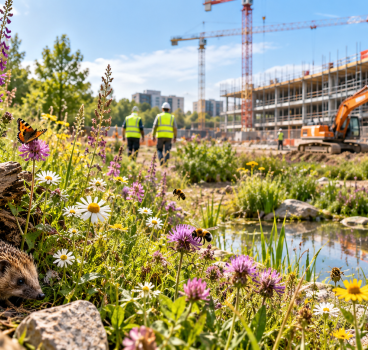
Rewilding construction sites to boost local biodiversity
At a time when the UK is facing a serious decline in wildlife, the construction industry has an opportunity to rethink its relationship with the natural environment. So let’s ask the question - could...
Read more