
Are we addicted to concrete and is it holding us back?
Concrete is everywhere. It shapes our cities, underpins our infrastructure and in many ways, defines modern construction. It is reliable, familiar and deeply embedded in how we design and build. But that familiarity raises an uncomfortable question - have we become too dependent on it? writes John Ridgeway.
Because while concrete has enabled scale and speed, it may also be limiting how the industry evolves, particularly at a time when sustainability, efficiency and adaptability are becoming more important than ever.
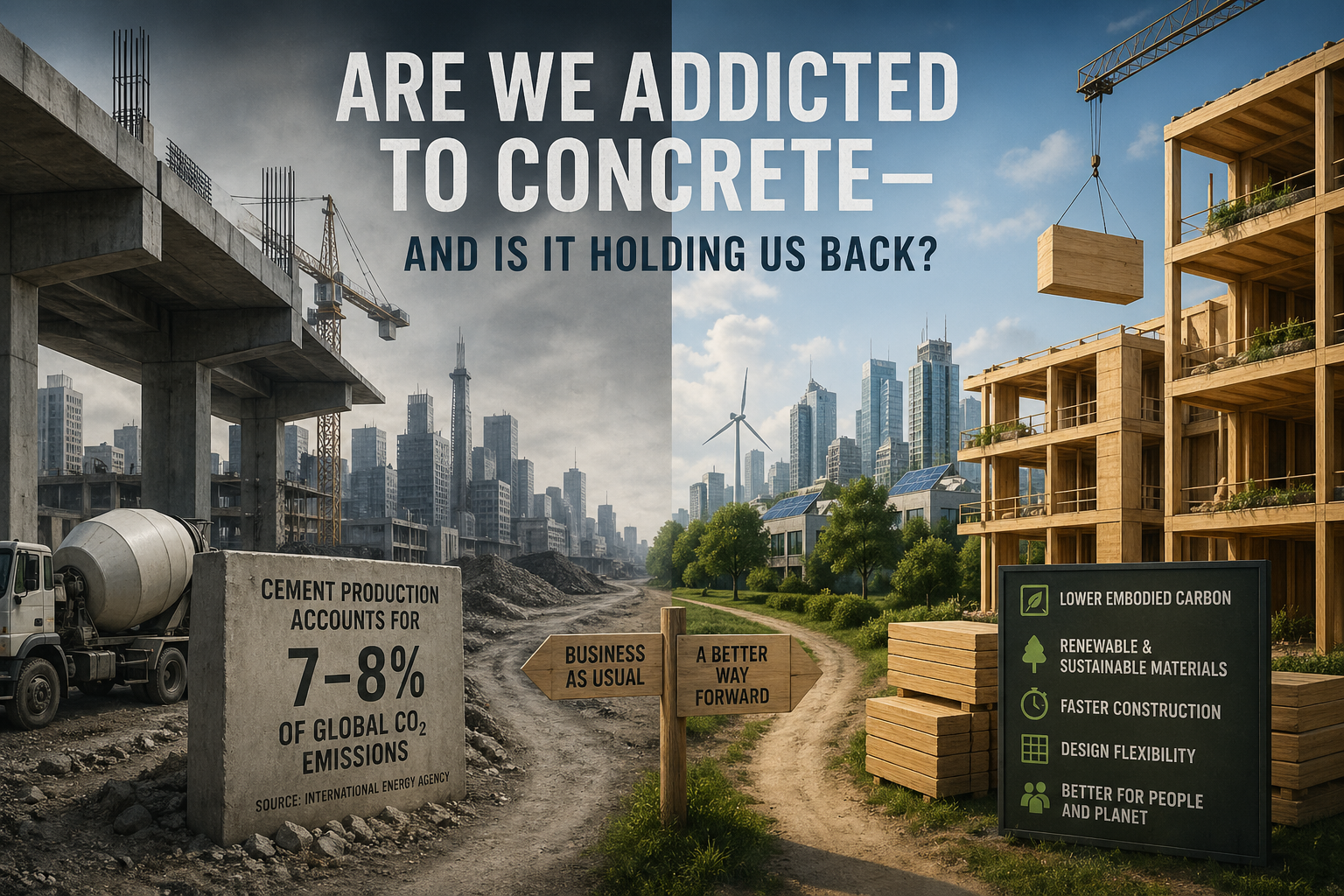
It is difficult to overstate the importance of concrete. It is the most widely used man-made material on earth, with billions of tonnes produced every year. According to the International Energy Agency, cement production alone accounts for around 7 to 8% of global CO₂ emissions, largely due to the energy-intensive process required to produce clinker.
That statistic highlights both sides of the story. Concrete has made modern construction possible at scale, but it has also created a significant environmental burden.
Its popularity is easy to understand. Concrete is versatile, relatively low-cost, fire-resistant and capable of forming almost any shape. It performs well under compression and has been the backbone of structural design for decades. For many engineers and contractors, it is the default choice, not because it is always the best option, but because it is the most familiar and that familiarity is where the challenge begins.
Default Choice or Best Choice?
In many projects, concrete is not selected after comparison, it is assumed from the outset. Design standards, supply chains and contractor experience are all aligned around it. That creates efficiency, but it can also create inertia. The industry has, in effect, built itself around a single material system.
Research and commentary highlighted by the World Green Building Council suggests that reducing embodied carbon in construction will require a fundamental rethink of material choices, not just incremental improvements. Yet in practice, many projects continue to rely heavily on concrete, even where viable alternatives exist.
This is not necessarily because those alternatives are unsuitable, but because they are less understood, less standardised or perceived as higher risk.
Materials such as engineered timber, recycled composites and low-carbon binders are gaining attention. Cross-laminated timber (CLT), for example, offers significant reductions in embodied carbon and faster construction times in certain applications. Innovations in geopolymer concrete and other cement alternatives are also beginning to challenge traditional approaches. Despite this, adoption remains relatively slow.
Part of the issue is structural. Building regulations, insurance frameworks and procurement processes are often designed around established materials. Introducing alternatives can require additional approvals, testing and justification, which increases complexity and perceived risk.
There is also a cultural factor. Construction is an industry built on experience and experience tends to favour what is known to work. Concrete has a long track record. Newer materials, even when proven, do not yet have the same level of trust.
Performance vs Impact
Another layer to the debate is performance. Concrete is often chosen because it delivers predictable results. It is durable, widely available and supported by a mature supply chain. However, performance is not just about strength or lifespan, it is also about environmental impact, adaptability and long-term value.
As pressure increases to meet net zero targets, the embodied carbon of materials is becoming a critical consideration. Reports from organisations such as the United Nations Environment Programme have emphasised the need to reduce emissions from construction materials if global climate goals are to be achieved.
This puts concrete under scrutiny. The question is no longer just whether it performs structurally, but whether it performs sustainably.
One of the more subtle issues is how material choice influences design itself. Concrete enables certain types of structures, such as large spans, heavy frames, monolithic forms. Over time, these possibilities have shaped architectural and engineering norms. In some cases, buildings are designed with concrete in mind from the outset, rather than selecting materials based on the specific needs of the project.
This can lead to a form of design bias, where alternative approaches are not fully explored. Historically, construction has adapted to available materials. Today, it could be argued that we are doing the opposite, selecting materials first and designing around them.
None of this suggests that concrete should be abandoned. It remains an essential material, particularly in infrastructure and applications where its properties are difficult to replicate. The risk lies not in using concrete, but in relying on it without question.
Industries that fail to evolve often do so not because they lack innovation, but because they are too comfortable with existing solutions. Construction is no different. The challenge is not just to develop new materials, but to create the conditions in which they can be adopted confidently. That includes changes in regulation, procurement and industry culture.
A Change in Thinking
However, there are signs that change is coming. Clients are increasingly asking about embodied carbon. Designers are exploring hybrid structures that combine materials rather than relying on a single system. Contractors are becoming more open to new methods, particularly where they offer programme or cost advantages.
At the same time, investment in research and development is growing, with organisations and governments recognising the need to decarbonise the built environment, but progress is uneven and the scale of change required is significant.
Addiction might be too strong a word, but dependence is not. Concrete has become the default language of construction. It is what we know, what we trust and what our systems are built around. That makes it powerful, but also potentially limiting.
The real question is not whether concrete is good or bad. It is whether we are giving ourselves permission to look beyond it. Because if the industry is to meet the challenges ahead, sustainability, efficiency, resilience, it will need more than incremental change.
It will need to rethink not just how we build, but what we build with and that starts by asking a simple question more often - is concrete the best choice or just the easiest one?
Frequently Asked Questions
1. Why is concrete used so widely in construction?
Concrete is widely used because it is strong, durable, versatile, fire-resistant and relatively cost-effective. It can be moulded into almost any shape and has formed the backbone of buildings, bridges and infrastructure projects for more than a century.
2. What is the environmental impact of concrete?
Concrete has a significant environmental impact because cement production generates large amounts of carbon dioxide. According to the International Energy Agency, cement production is responsible for around 7–8% of global CO₂ emissions.
3. Is concrete bad for the environment?
Concrete itself is not inherently bad, but its production is carbon intensive. The challenge for the construction industry is to reduce embodied carbon by improving concrete mixes, increasing recycled content and using lower-carbon alternatives where appropriate.
4. What are the alternatives to concrete in construction?
Alternatives include engineered timber such as cross-laminated timber (CLT), geopolymer concrete, recycled aggregates, low-carbon cement, steel, bamboo and hybrid structural systems that combine multiple materials.
5. What is embodied carbon in construction?
Embodied carbon is the total greenhouse gas emissions associated with extracting raw materials, manufacturing products, transporting them and constructing a building before it is occupied.
6. Why is the construction industry looking beyond concrete?
The industry is seeking lower-carbon materials to help achieve net zero targets, reduce embodied carbon and improve the environmental performance of buildings while maintaining structural safety and durability.
7. Can timber replace concrete?
Engineered timber can replace concrete in many low-rise and mid-rise buildings, offering significant reductions in embodied carbon. However, concrete remains essential for many infrastructure projects and applications requiring high compressive strength or specific durability.
8. What is low-carbon concrete?
Low-carbon concrete uses alternative cementitious materials, recycled aggregates or innovative binders to reduce carbon emissions compared with traditional Portland cement concrete while maintaining structural performance.
9. Why do designers often choose concrete by default?
Concrete has a long history of proven performance, well-established design standards and a mature supply chain. This familiarity often makes it the default specification, even when alternative materials may offer environmental or programme benefits.
10. Will concrete always be needed in construction?
Yes. Concrete is likely to remain essential for many applications, including foundations, tunnels, bridges and major infrastructure. The focus is increasingly on using it more efficiently and only where it offers the greatest value.
11. What is a hybrid building structure?
A hybrid structure combines different materials, such as concrete, steel and timber, to optimise structural performance, reduce embodied carbon and improve construction efficiency by using each material where it performs best.
12. How can construction reduce its dependence on concrete?
Reducing dependence on concrete involves considering alternative materials during design, specifying low-carbon concrete where appropriate, increasing the reuse of existing structures, adopting hybrid construction methods and focusing on whole-life carbon performance rather than initial cost alone.
Additional Blogs

The Robotics as a Service Revolution Is Reshaping Warehouse Infrastructure Requirements
Warehouse operators now rent automation equipment instead of purchasing it outright. These robotics as a service models provide access to advanced machines without major capital investments. As...
Read moreIs construction becoming brilliant at measuring everything except common sense
Construction has never had access to more information. We can track the progress of a project almost in real time. We can monitor costs, labour, productivity, programme performance, carbon, waste,...
Read more
Rewilding construction sites to boost local biodiversity
At a time when the UK is facing a serious decline in wildlife, the construction industry has an opportunity to rethink its relationship with the natural environment. So let’s ask the question - could...
Read more